











































For many years historians believed that the Fylde Coast was little more than an inhospitable landscape of marshes, bogs and tidal creeks during the Roman occupation of Britain. While Roman forts stood at Kirkham, Ribchester and Lancaster, there appeared to be little evidence that people had settled permanently on the Fylde itself. That assumption changed dramatically in 2008. During work to install a new sewer pipeline on farmland east of Poulton-le-Fylde, archaeologists made a discovery that would transform our understanding of Roman Lancashire. Hidden beneath centuries of soil lay the remains of a previously unknown Romano-British farming settlement, providing the first substantial evidence that people were living and working on the Fylde throughout the Roman period.
An Unexpected Discovery
The excavation took place on land north of Garstang Road East as part of a programme of archaeological work undertaken before construction of a new United Utilities pipeline. What initially appeared to be a routine excavation soon revealed something far more significant. Archaeologists uncovered the remains of an enclosed Romano-British settlement, complete with circular timber buildings, enclosure ditches, storage pits and evidence of everyday agricultural life. The discovery was one of the most important Roman-period archaeological finds ever made on the Fylde Coast.
The Roundhouses
At the heart of the settlement were two substantial roundhouses. The largest measured approximately ten metres in diameter and was constructed using timber posts set within concentric circular gullies. The outer gully acted as a drainage channel, while the inner ring supported a wall of timber, probably finished with woven wattle and daub. A large central post would have carried the weight of a conical thatched roof. Unlike many Iron Age roundhouses, the Poulton building appears to have had two opposing entrances aligned east to west, allowing sunlight and warmth to enter the dwelling during the day. Inside, archaeologists identified a large storage pit together with evidence of domestic activity, suggesting this was a permanent family home rather than a temporary shelter. Radiocarbon dating and the recovered pottery indicate that the settlement was occupied during the late second and into the mid-third century AD.
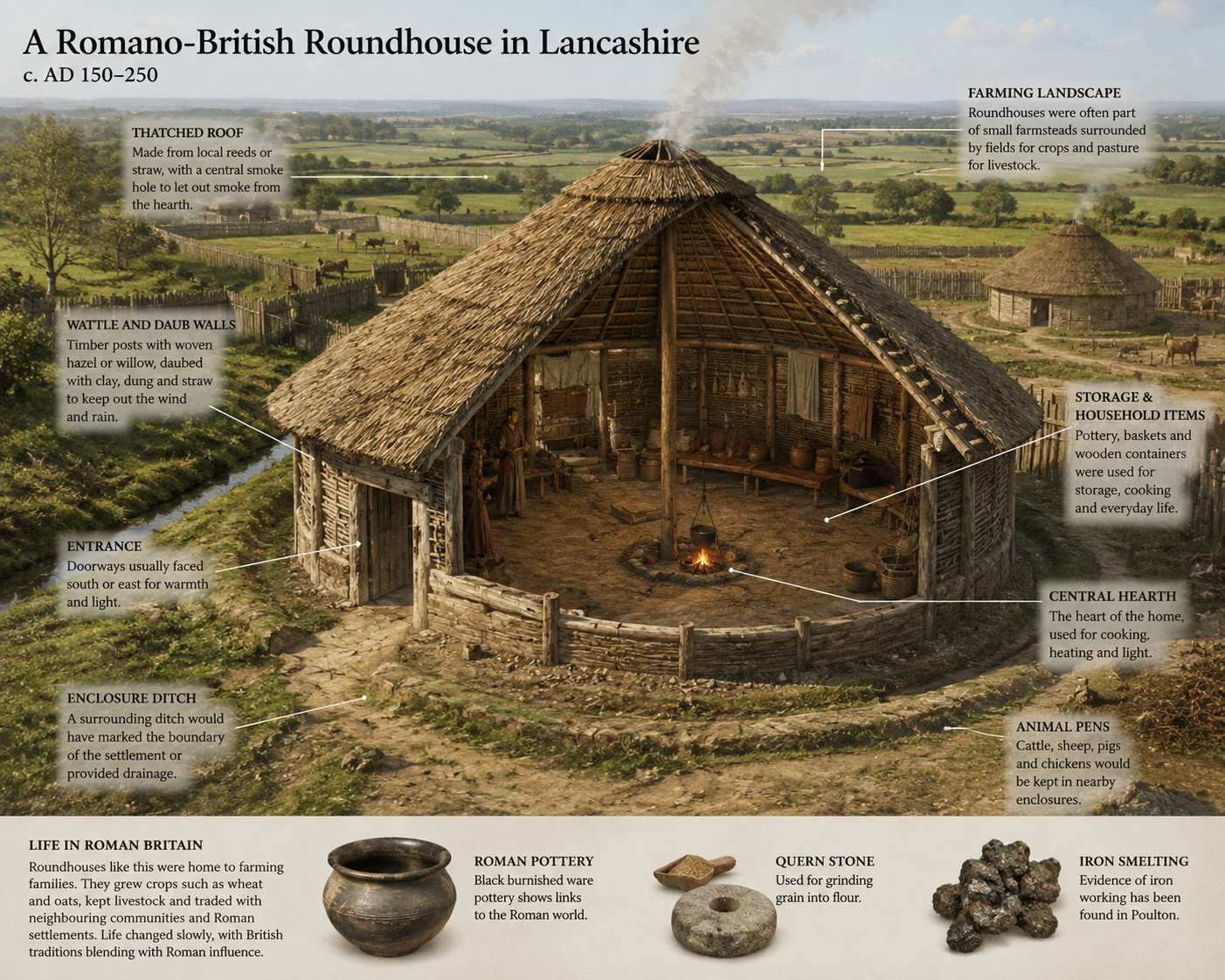
Illustration provided by © DeeperBlue Marketing & Design Limited
Life on Roman Fylde
Although Britain had been under Roman rule for well over a century, the people living at Poulton continued to build their homes in the traditional Iron Age style. This illustrates an important aspect of life in Roman Britain. Outside the major towns and military forts, many native communities retained their own customs and architecture while gradually adopting aspects of Roman culture. The Poulton settlement was principally agricultural. Evidence recovered during the excavation showed that the inhabitants cultivated oats, emmer wheat and spelt wheat. Fragments of quern stones used for grinding grain were discovered, while burnt animal bone indicated that livestock formed an important part of the local economy. The settlement occupied a small, well-drained rise overlooking what is now the Main Dyke, then a natural watercourse that would have provided fresh water and easy access across the surrounding landscape. Enclosure ditches protected the farmstead, while traces of a trackway running westwards suggest connections to neighbouring settlements or a wider route across the Fylde.
Roman Influence Reaches Poulton
Although the houses themselves were unmistakably British in design, the artefacts discovered inside revealed the influence of Rome. Among the 171 fragments of pottery recovered were pieces of black burnished ware, one of the most common Roman domestic ceramics in Britain. Archaeologists also found fragments of mortaria, heavy mixing bowls used in Roman food preparation. These imported goods demonstrate that the inhabitants of Poulton were participating in the wider Roman economy. They were not isolated farmers living beyond civilisation but members of a community trading with neighbouring settlements and, quite possibly, with nearby Roman military sites.
The presence of Roman pottery suggests the settlement was producing enough surplus food to exchange for manufactured goods, indicating a prosperous farming community rather than a subsistence settlement.
Industry on the Fylde
The story did not end there. Further archaeological investigations carried out nearby in 2018 uncovered additional Romano-British activity, including evidence of iron smelting. Large quantities of slag and furnace waste revealed that iron was being worked on the site during the Roman period. This discovery is particularly significant because it represents one of the earliest known examples of iron production in Lancashire outside a military context. Rather than simply growing crops and raising animals, the people of Roman Poulton were also involved in small-scale industrial production, adding another dimension to our understanding of life on the Fylde nearly two thousand years ago.
The Setantii Connection
At the time these roundhouses were occupied, the Fylde is thought to have formed part of the territory of the Setantii, a coastal people known only from the writings of the Roman geographer Claudius Ptolemy around AD 150. Many historians believe the Setantii were a branch of the Brigantes, northern Britain’s largest tribal confederation. Although no archaeological evidence can directly identify the Poulton inhabitants as members of the Setantii, they almost certainly lived within the area traditionally associated with that tribe.
The settlement also lies close to the route of a long-suspected Roman road leading west from Kirkham towards the elusive Portus Setantiorum, the mysterious “Port of the Setantii” recorded by Ptolemy. Although no trace of the road has yet been conclusively identified, the Poulton discovery strengthens the case that the Fylde was far more active during the Roman period than once believed.
Rewriting Fylde History
Before the Poulton excavations, historians generally viewed the Fylde as sparsely populated during Roman times. The discovery of the roundhouses challenged that long-held belief. Instead of an empty marshland lying beyond the edge of civilisation, archaeologists revealed a settled farming landscape inhabited by communities who successfully blended native traditions with Roman influence. These people cultivated crops, kept livestock, traded for imported goods and even worked iron, all while continuing to live in traditional British roundhouses. Together with discoveries such as the Rossall Roman Hoard, Roman finds at Skippool and the fort at Kirkham, the Poulton settlement paints a picture of a thriving landscape connected to the wider Roman world.
The excavations at Poulton have fundamentally changed our understanding of the Roman Fylde. They demonstrate that, nearly 2,000 years ago, the area was not a forgotten frontier but home to a settled and productive community whose story is only now beginning to emerge from beneath the fields of Lancashire.
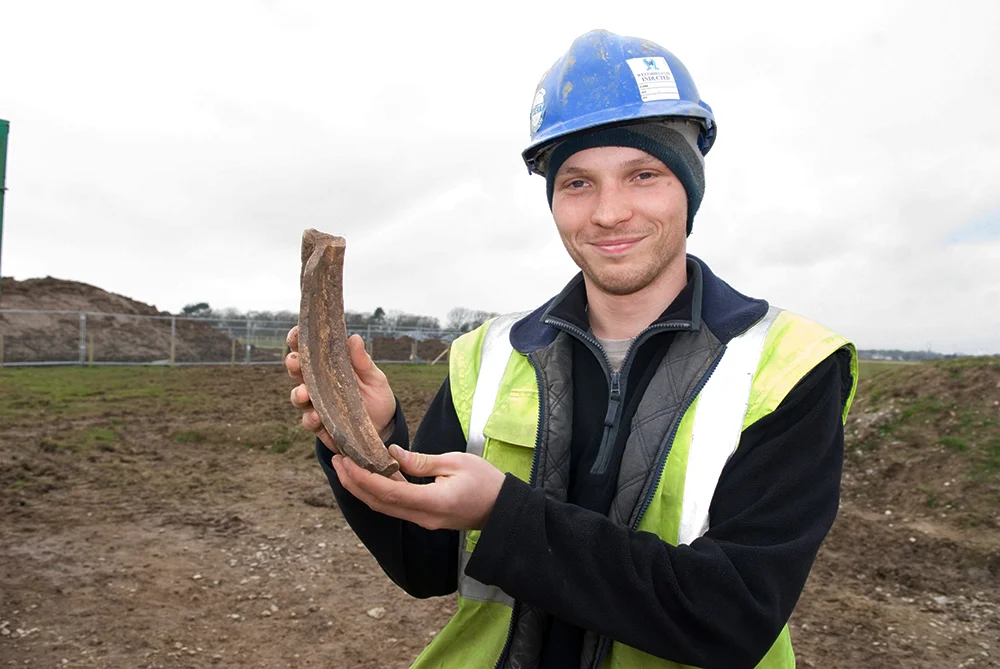
Roman remains found in field Poulton-le-fylde Lancashire. 22 March 2008.
Featured Image © Alamy
Background Image © Deeper Blue Marketing & Design Ltd


