



























Few episodes in Blackpool’s history are as unusual as the story of the Sands Express. For a few remarkable months during 1911, visitors strolling along the Promenade were greeted not only by the town’s famous electric trams but also by a fleet of steam locomotives hauling wagonloads of sand beside the seafront. The temporary railway became one of Blackpool’s most extraordinary engineering projects and played a crucial role in creating part of the modern promenade visitors enjoy today. The project arose from Blackpool Corporation’s ambitious programme of promenade improvements during the early twentieth century. Following the construction of a substantial 18-foot-high concrete sea wall near the Metropole Hotel, engineers were left with a large gap between the new wall and the original coastline. To create new land behind the sea defences, an estimated 250,000 tons of sand had to be transported from South Shore to North Shore.
Transporting such an enormous quantity of sand presented a significant challenge. Horse and cart would have been slow and expensive, while using Blackpool’s tramway risked damaging the tracks and disrupting passenger services. Instead, Borough Engineer James Shanks Brodie approved the construction of a temporary standard-gauge industrial railway, which quickly became known as the Sands Express. Temporary rails were laid along the Promenade, creating an unusual sight as steam locomotives operated alongside the town’s electric trams. The railway’s first locomotives were the saddle tank engines Netherton and Horbury, both arriving via the Lancashire and Yorkshire Railway before making their way through Blackpool’s streets to the seafront. Each engine could haul up to twelve wagons loaded with sand.
The operation began on the beach close to Victoria Pier, now known as South Pier, where around 80 labourers dug sand by hand using shovels. Loaded wagons travelled along temporary tracks across the beach before reaching the incline at Waterloo Road, known as Waterloo Junction. There, one locomotive hauled the train up onto the Promenade while another continued the journey north towards the Metropole. Returning empty, the locomotives became something of a local spectacle. They were capable of reaching speeds approaching 40 miles per hour, easily overtaking Blackpool’s trams, which travelled at around 12 miles per hour. Crowds often gathered to watch these informal races, creating an unexpected attraction during the engineering works.
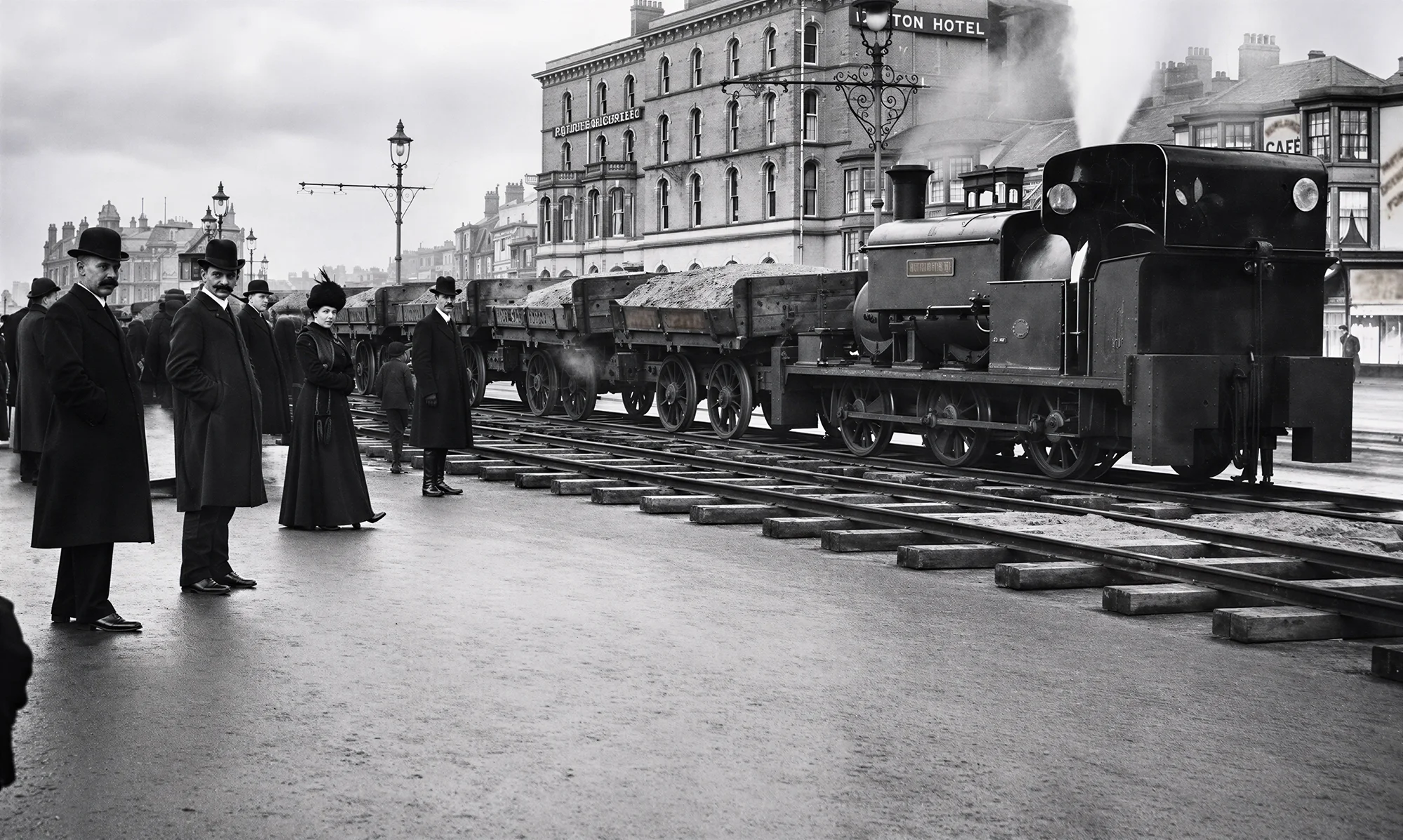
Original image provided by the amounderness.co.uk website
The project was not without its difficulties. Poor-quality coal prevented the engines from maintaining sufficient steam pressure, slowing progress considerably. To keep the work on schedule, a third locomotive named Reliance was introduced. Although more powerful and capable of hauling twenty wagons, it gained an unfortunate reputation for repeatedly leaving the rails, causing delays and blocking the temporary line. As winter weather worsened, a fourth locomotive, Annie, arrived in February, followed by a fifth, Alice, in April to help complete the final stages of the project. The construction work also brought challenges for local residents. Smoke from the locomotives drifted across hotels and boarding houses, while soot, coal dust and sand settled along the Promenade. Landladies complained of constantly cleaning their properties, and nearby residents objected to the whistles of the locomotives, which often continued throughout the night as work progressed around the clock.
Despite these setbacks, the railway successfully completed its task during May 1911. Once the last train had run, the temporary tracks were removed, leaving only faint impressions in the roadway. The reclaimed land became Princess Parade, officially opened by Princess Louise, Duchess of Argyll, on 1 May 1912. Covering around 4½ acres, the project had cost more than £40,000, while over 4,000 tons of basalt blocks, imported from Northern Ireland and Germany, were used to face the new sea wall. The reclaimed land would later become home to some of Blackpool’s most significant landmarks. Among them was the Blackpool War Memorial, unveiled in 1923, standing on ground created by the thousands of tons of sand carried by the Sands Express. Every visitor who walks along this section of the Promenade today is unknowingly crossing land built by one of the town’s most ambitious engineering projects.
Although the Sands Express operated for only a few months, it remains one of the most fascinating chapters in Blackpool’s history. It demonstrated the ingenuity and determination of the town’s engineers during a period of rapid expansion, while creating an unforgettable spectacle of steam locomotives running beside electric trams along Britain’s most famous seafront. Today, no trace of the railway survives, but its legacy lives on in the very landscape of Blackpool’s Promenade.
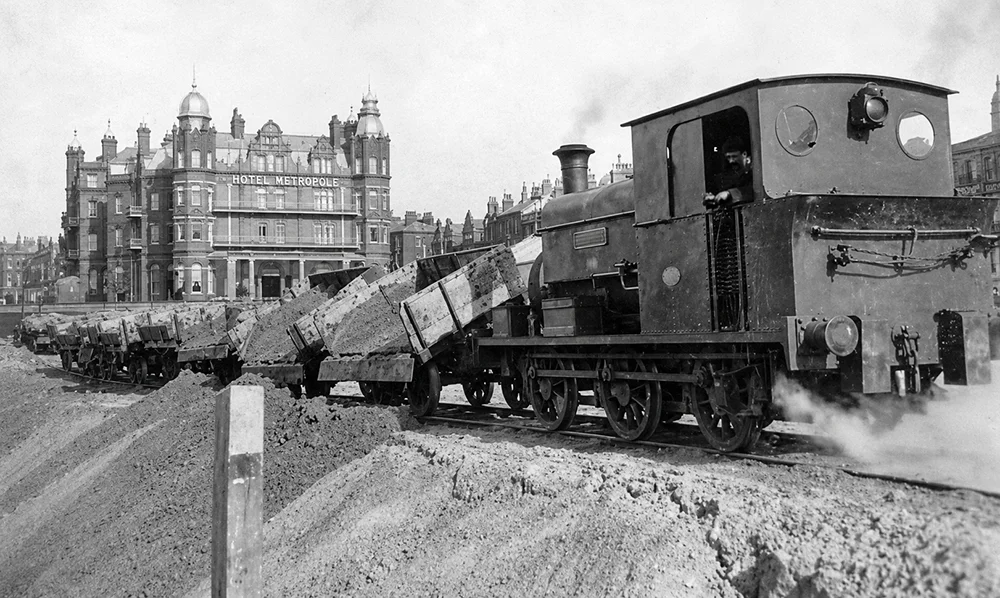
Featured Image © Blackpool Council/Heritage Service
Background Image © https://amounderness.co.uk


