





























Few souvenirs have become as closely associated with Blackpool as the humble postcard. For well over a century, millions of visitors have posted colourful views of the Tower, the Golden Mile, the Illuminations and the Pleasure Beach to friends and family across Britain and around the world. Today these postcards have become far more than holiday keepsakes—they provide an invaluable visual record of Blackpool’s remarkable transformation from a small coastal village into Britain’s best-known seaside resort.
Although postcards had existed in various forms during the nineteenth century, the modern picture postcard arrived in Britain relatively late. While illustrated postcards were already hugely popular across mainland Europe, restrictions imposed by the British Post Office limited their development. Early British cards were smaller than their Continental counterparts and required both the message and the picture to share the same side, leaving little room for either. This changed in November 1899, when the Post Office adopted the larger Continental format following lobbying by publishers including Raphael Tuck & Sons, paving the way for the postcard boom that followed.

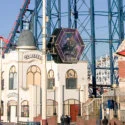
Old 1900s vintage seaside picture postcard of the Floral Hall Winter Gardens Blackpool.
Blackpool embraced the new craze at exactly the right moment. By the turn of the twentieth century the resort was attracting millions of visitors every year, all eager to send a reminder of their holiday home. Ironically, when the first picture postcards appeared in Blackpool during 1898, one local newspaper remarked that there seemed to be little demand for them. That prediction proved spectacularly wrong. Within only a few years, postcards had become one of the town’s biggest-selling souvenirs, with thousands being posted every day during the holiday season.
The earliest Blackpool postcards concentrated on the town’s rapidly expanding landmarks. The Blackpool Tower, North Pier, Central Pier, Winter Gardens, Promenade, Talbot Square and the bustling seafront became favourite subjects, while photographers also recorded hotels, boarding houses, trams, gardens and busy street scenes. These images now provide historians with an extraordinary visual record of buildings and attractions that have long since disappeared, allowing the changing face of Blackpool to be traced almost year by year.

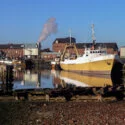
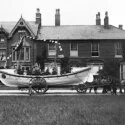
Old vintage seaside picture postcard Blackpool.
Several leading publishers helped shape the postcard industry. Raphael Tuck & Sons produced beautifully printed colour and embossed cards, while Valentine & Sons, Francis Frith & Co. and Judges Postcards built extensive catalogues covering Blackpool and the wider Fylde Coast. Their photographers captured not only famous landmarks but also ordinary streets, local businesses and everyday life, creating an invaluable archive of the resort’s social history. Following the introduction of the divided-back postcard in 1902, correspondents could write their message on one side while enjoying a full-sized photograph on the other, further increasing the popularity of postcards.
As the twentieth century progressed, postcards became increasingly imaginative. Multi-view designs showcased several attractions on a single card, while novelty postcards featured folding panoramas, silk inserts and other innovative formats. Blackpool also became synonymous with the comic seaside postcard, a uniquely British tradition that flourished throughout the twentieth century. The resort’s carefree holiday atmosphere provided the perfect backdrop for humorous illustrations featuring exaggerated characters, holiday romances, mischievous children and the cheeky double entendres that became known as “saucy postcards.”

Saucy seaside postcards.
The most famous artist associated with the genre was Donald McGill, whose colourful illustrations earned him the title “The King of the Saucy Postcard.” Although his work was sold throughout Britain’s seaside resorts, Blackpool became one of its spiritual homes, with postcard racks outside souvenir shops displaying hundreds of his designs alongside scenic views of the resort. McGill’s humour pushed the boundaries of what was considered acceptable at the time, and in 1954 he was even prosecuted under the Obscene Publications Act for a selection of his postcards. While the case attracted national newspaper coverage and sparked debate about censorship and public decency, the court imposed only a modest fine. Ironically, the publicity only increased interest in the postcards, cementing their place in British popular culture. A video about the censorship and his impact on the postcard landscape can be viewed below:
By the post-war years, rotating postcard displays had become an iconic feature of Blackpool’s streets. Visitors could choose from stunning colour photographs of the Illuminations, Pleasure Beach, Tower Ballroom and the Golden Mile, or browse rows of comic cards that captured the light-hearted spirit of the British seaside holiday. The combination of scenic photography and saucy humour proved irresistible, with millions of postcards finding their way into homes across Britain every summer.
During the 1950s and 1960s, improvements in colour photography transformed postcard production still further. Vibrant images reflected the optimism of the post-war holiday boom, preserving not only the town’s famous attractions but also its changing architecture, transport and fashions. Many photographers recorded streets and buildings that have since disappeared, making these postcards an invaluable historical resource as well as a souvenir.
Today, historic Blackpool postcards are highly prized by collectors, local historians and family researchers. Beyond their nostalgic appeal, they preserve details that often escaped official records, including vanished buildings, changing shopfronts, lost attractions, early motor vehicles and everyday scenes of visitors enjoying their holidays. Comic postcards have also gained recognition as important social documents, reflecting changing attitudes towards humour, censorship and British culture during the twentieth century.
More than a simple memento, the Blackpool postcard became a visual diary of Britain’s favourite seaside resort. Whether capturing the elegance of Victorian Blackpool, the dazzling spectacle of the Illuminations or the mischievous humour of the famous saucy postcards, these small pieces of card have preserved the story of the town for well over a century. Today they remain among the richest historical sources for understanding the evolution of Blackpool and the memories created by the millions of people who have visited its shores.

Blackpool cartoon postcard example.


