



























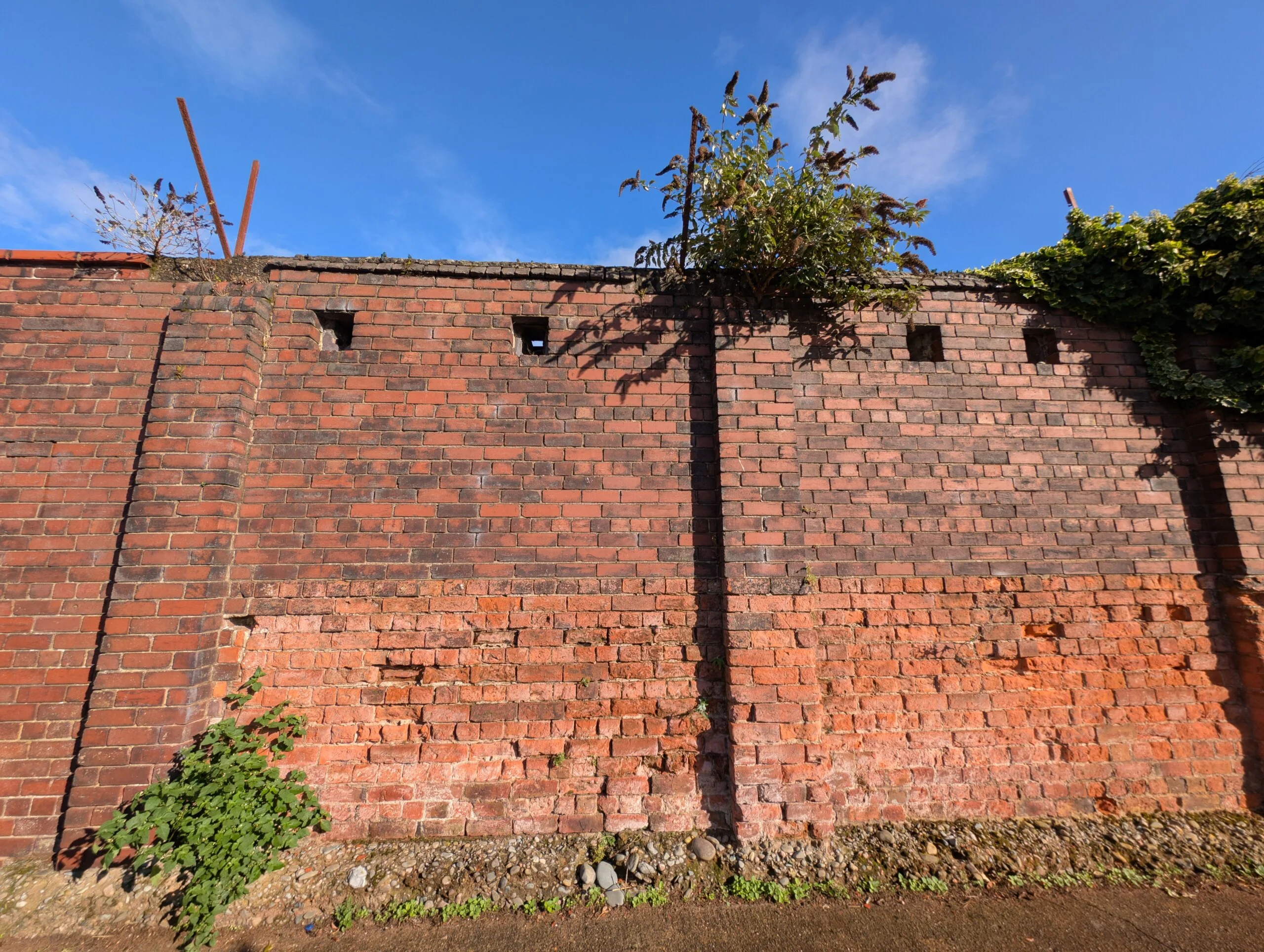
A tall brick wall hidden down an alley off Grasmere Avenue and Coniston Avenue preserves a little-known part of Fleetwood’s military past. Now surrounded by homes, it once enclosed part of the Hutment Barracks, where soldiers were accommodated and ammunition stored. Its weathered surface and small openings near the top offer surviving evidence of a period when military establishments occupied substantial areas of the town.
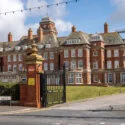
Fleetwood’s development as a garrison town gathered pace following the government’s acquisition of the North Euston Hotel in 1859. The hotel entered military use and housed a School of Musketry, while a separate barracks complex developed near Poulton Road and Beach Road, opposite the Queens Hotel. Rifle ranges towards Rossall Point completed a network of facilities supporting accommodation, weapons instruction and shooting practice. Parish records from 1863 recorded musketry instructors and sergeants living in Fleetwood, reflecting the military community established alongside the town’s maritime population.
Known as the Hutment Barracks, the enclosure contained several buildings with distinct functions. Soldiers’ quarters stood within a compound that also included a military hospital and ammunition magazines. The barracks provided accommodation for troops, while the coastal ranges offered space for practical training in marksmanship. These establishments brought the routines of army service into Fleetwood, connecting the town’s streets with training grounds along its exposed western shore.
The storage of ammunition became an important responsibility. Two magazines completed in October 1878 provided dedicated facilities for military supplies. Local historical accounts recorded that ammunition was moved south by train following the outbreak of the First World War in 1914, with soldiers guarding railway bridges along the route. Although occupation of the wider barracks subsequently became intermittent, a military detachment continued guarding the magazines until 1921. A photograph held by Lancashire County Council, dated approximately 1917, also showed soldiers unloading ammunition on Fleetwood quay, recording another aspect of the port’s wartime work.
The surviving wall retains features associated with protecting the enclosure. Small openings near its upper edge have been identified by local antiquarian researchers as rifle loopholes. Narrower on the outward-facing side, these openings allowed defenders to fire through the wall while remaining sheltered behind its brickwork. Their presence demonstrated provision for defence, although there is no confirmed evidence that the wall was used during an attack. Changes in the brickwork suggest alterations over time, but their precise dates remain uncertain.
After military use declined, redevelopment gradually replaced the barracks with residential streets. Buildings that had housed soldiers and supported their work disappeared, while sections of the boundary survived among the new properties. The wall off Grasmere Avenue and Coniston Avenue remains a physical link to that earlier landscape, preserving the edge of a military compound where Fleetwood’s present-day neighbourhood once met the guarded world of barrack life.
Images by © Mitchell Morton


