







Larry Rushton had one of the more extraordinary routes into Blackpool’s artistic world. A safe-breaker, robber and prison escapee who discovered an ability to paint while behind bars, Rushton eventually became a successful self-taught artist associated with Blackpool and Lytham St Annes, producing paintings that ranged from clowns and tramps to portraits and scenes of working-class life.
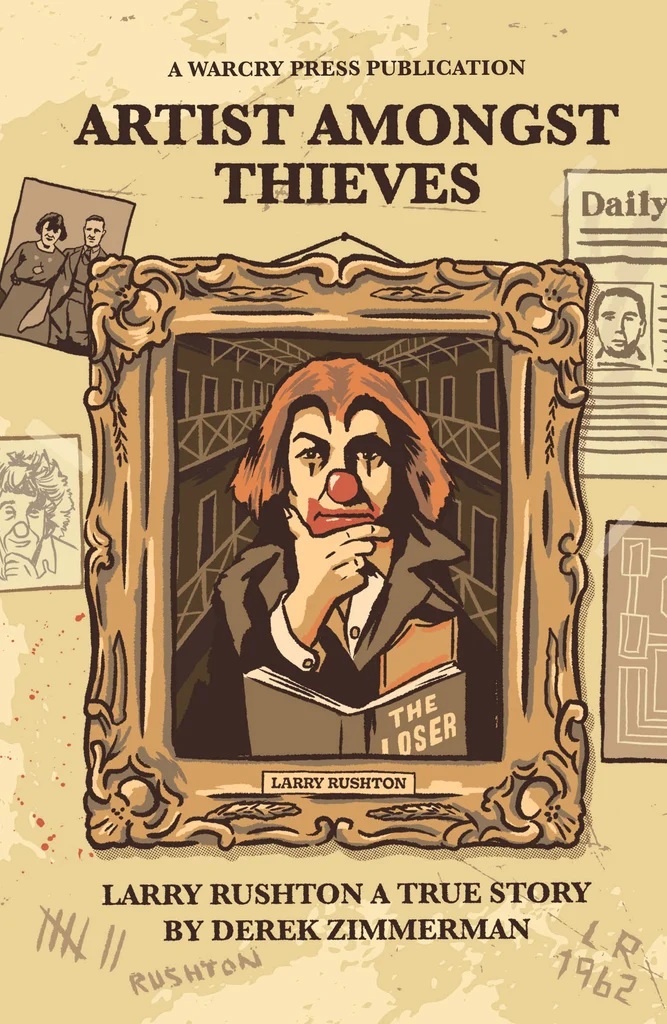
Click on image above to buy the book on Amazon.
Rushton was born in Burnley in May 1930 and died in 2006. His early life was spent in Lancashire, where he became involved in crime at the age of just 15. Much of the remarkable story of his life comes from Artist Amongst Thieves: Larry Rushton – A True Story, written by his brother-in-law Derek Zimmerman from Rushton’s own recollections and published by Warcry Press. According to that account, Rushton moved to London for a short period during his teenage years, but was arrested there at the age of 16 and sentenced to three years in Borstal. He was discharged after serving 18 months and returned to Burnley, although this did little to bring his criminal activities to an end.
Rushton went on to build a lengthy criminal career involving safe-breaking, burglary, robbery with violence, bank robbery and conspiracy. His activities took him beyond Lancashire, with burglaries reportedly carried out in London and Glasgow, where he targeted wealthy homes. Prison inevitably followed, although keeping Rushton there apparently presented its own difficulties. He escaped from Armley Prison in Leeds within hours of arriving and also escaped from Exeter Prison, where he had been transferred under increased supervision because the authorities suspected he might attempt to escape.
In 1953, aged 23, Rushton moved to Blackpool following his discharge from Wandsworth Prison. He found employment as a photographer on the Golden Mile, placing him among the entertainers, visitors, traders and colourful characters who made up the resort’s busy seafront life. It was an environment very different from the prisons in which he had spent much of his early adulthood, and one that would eventually become closely associated with his artistic career. Although Rushton had been born in Burnley, his subsequent connection with the Fylde Coast became so strong that he was later described in auction catalogues as a ‘Blackpool Artist’.
It was imprisonment that unexpectedly gave Rushton another direction in life. While being held in solitary confinement, he began creating pictures on his cell walls and door using the black wax provided for prison mailbags. According to the story preserved by his family, a prison governor recognised that Rushton possessed genuine artistic ability and encouraged him to develop it, suggesting that art might offer him an alternative to the life he had been leading. Rushton had no conventional artistic training, but painting gradually developed into considerably more than a prison pastime. Clowns became particularly associated with his work. One of his best-known pictures, The Loser, was reportedly painted while he was imprisoned in Hull. Other clown pictures followed, including Reflections, which was later reproduced as a limited-edition print, and The Great Popo, a surviving work signed and dated 1974. His paintings frequently concentrated on people rather than grand landscapes. Tramps, elderly men, street characters, working people and figures encountered in everyday life appeared repeatedly among his surviving works, with titles including Butcher Boys, Man on a Park Bench, Northern Life and Figures on a Cobbled Street.
An important turning point came in 1974 when Rushton met art dealer Rodney Jones, who owned the Quest art shop in Lytham. Jones recognised the appeal of Rushton’s paintings and began displaying them in his shop, subsequently becoming his agent. The relationship helped introduce Rushton’s work to a wider audience and provided a more organised route into the commercial art world. His paintings attracted considerable interest, and exhibitions followed. At the Birmingham International Spring Fair, his work reportedly sold out within just ten minutes of opening, demonstrating the remarkable demand that had developed for paintings by an artist with no formal training. His growing reputation continued into 1977, when he exhibited at the John Gerrard Gallery in Hoylake.
Rushton’s paintings also became familiar sights in restaurants across Blackpool and Lytham St Annes. Local restaurant owners were keen to purchase his work and display it on their premises, bringing his paintings into public spaces where they could be enjoyed by diners as well as private collectors. These local connections helped establish Rushton as a recognisable figure within the Fylde Coast’s artistic and social circles. Comedian Les Dawson was among those associated with his work, and the two men met at the St Ives Hotel in St Annes. Dawson reportedly owned one of Rushton’s paintings, further illustrating the artist’s growing appeal beyond conventional gallery audiences.
Rushton also moved among some of the more colourful characters associated with post-war Blackpool. Among his acquaintances were Mixie Walsh and Dr Ken McGill, figures connected with the town’s clubs, boxing and nightlife. The precise circumstances in which Rushton first met Walsh have not been established, although their connections within Blackpool’s social circles may have brought them together. There are recollections that Rushton either intended to paint or actually completed a picture of Mixie Walsh on Blackpool’s Golden Mile, although no confirmed example of the painting has yet been traced. One surviving painting provides an even more intriguing connection. In 1961 Rushton painted a work entitled Blackpool Mary, which has subsequently appeared at auction. A woman known locally by the same name was part of the Blackpool social circle in which Rushton moved and was associated with Mixie Walsh. Her younger sister was Madge Leadbetter, whose murder in Blackpool on 31 May 1952 became one of the town’s notorious unsolved cases. Whether Rushton’s Blackpool Mary depicts this particular woman has not yet been conclusively established, but the connection is intriguing given Rushton’s links with the same circle of people.
His growing reputation eventually extended beyond the Fylde Coast. His family biography records that Rushton received a prestigious commission in the Middle East which significantly raised the profile and value of his work, although details of the client and painting have yet to be independently established. His transformation from criminal to artist was not entirely straightforward either. According to Zimmerman’s account, Rushton later became involved in an unusual incident after the owner of a transport business troubled by industrial action sought his advice about having a trade union figure assaulted. Rushton reportedly suggested Paul Sykes, the notorious boxer and prisoner whom he had known while serving time. The plan ended badly and Rushton received another 12-month prison sentence.
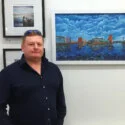
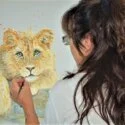
Despite this further encounter with the law, art remained the part of Rushton’s life for which he increasingly became known. By June 1982 he was sufficiently established locally for the Evening Gazette to photograph him with one of his paintings. The surviving press photograph, taken on 10 June and published on 16 June 1982, described him simply as ‘self-taught artist Larry Rushton’ – a considerable change from the man whose earlier years had been spent involved in crime and escaping from prisons.
Rushton died in 2006, but his work continued to surface in galleries and auction rooms long after his death. Paintings, watercolours and limited-edition prints have appeared across Britain, including portraits, landscapes, clowns and character studies. His association with the Fylde Coast also remained attached to his name. When Gerrards Auction Rooms in St Annes offered two signed oil portraits of elderly men in September 2015, the catalogue specifically described him as a ‘Blackpool Artist’. Other works have continued to emerge, including The Great Popo, dated 1974, and signed limited-edition prints entitled Tramps.
Larry Rushton therefore occupies an unusual position in Blackpool’s post-war story. He was neither a conventionally trained artist nor simply a local painter. His subjects frequently reflected people who might otherwise have been overlooked – clowns, tramps, elderly characters and ordinary working people – while his own life moved between prisons, crime, Blackpool’s colourful social circles and eventually galleries and private collections. Some of the stories surrounding him remain difficult to independently verify, particularly the more dramatic details of his criminal career, and much of what is known comes from Rushton’s own recollections recorded by his brother-in-law. What can be established is that he became a recognised self-taught painter with strong connections to Blackpool and Lytham St Annes. His arrival in the resort as a young photographer in 1953 marked the beginning of a long association with the town, while his meeting with Rodney Jones in 1974 helped transform his artistic ambitions into commercial success. By the late 1970s, Larry Rushton had established himself as an artist whose work was being exhibited, collected and displayed across the Fylde Coast and beyond.
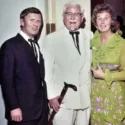
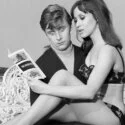
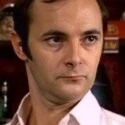
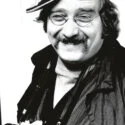
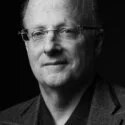
The featured image of Larry Rushton was provided by Derek Zimmerman but enhanced by Deeper Blue Marketing & Design Ltd. Many thanks go out to Derek for providing very valuable information in putting this post together.
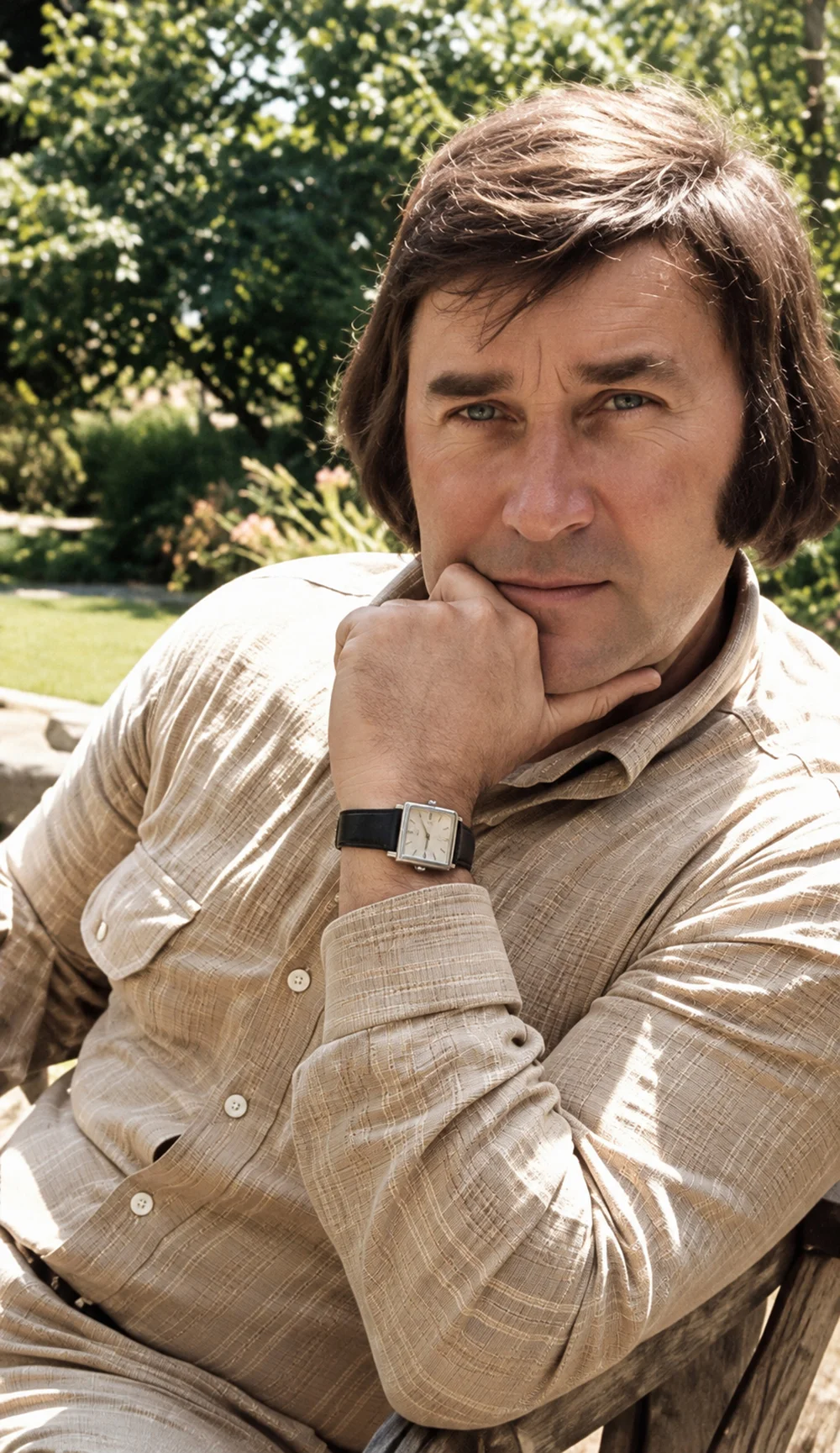
Image of Larry Rushton taken from Derek’s book


