



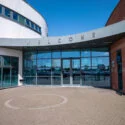


























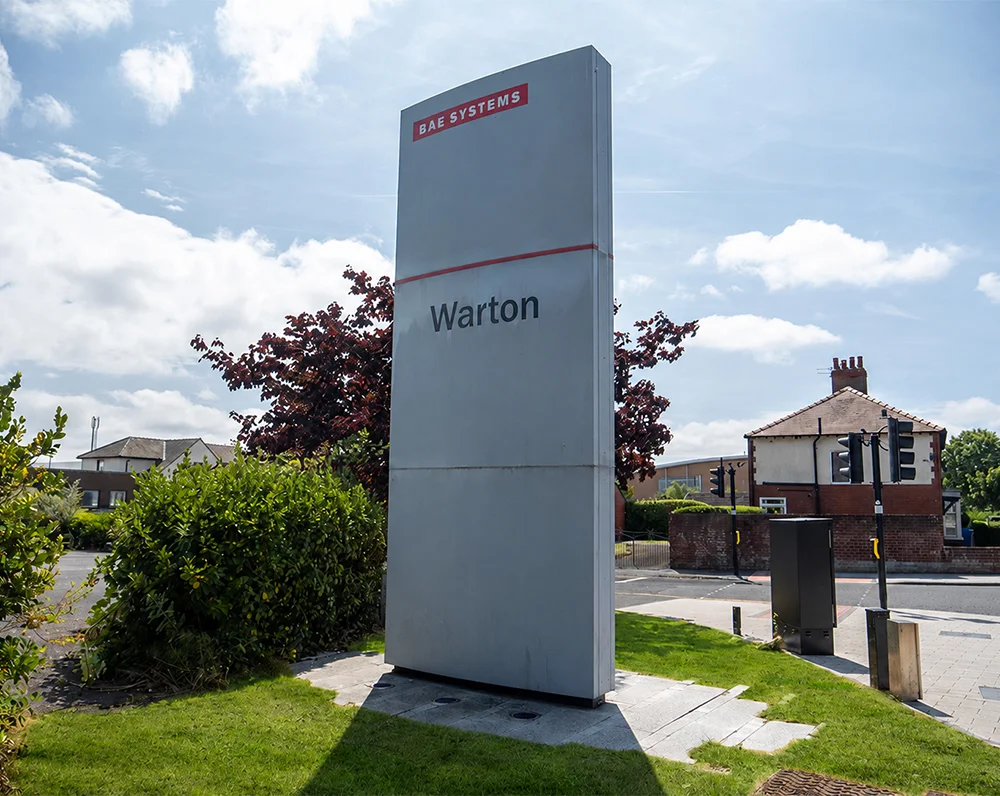
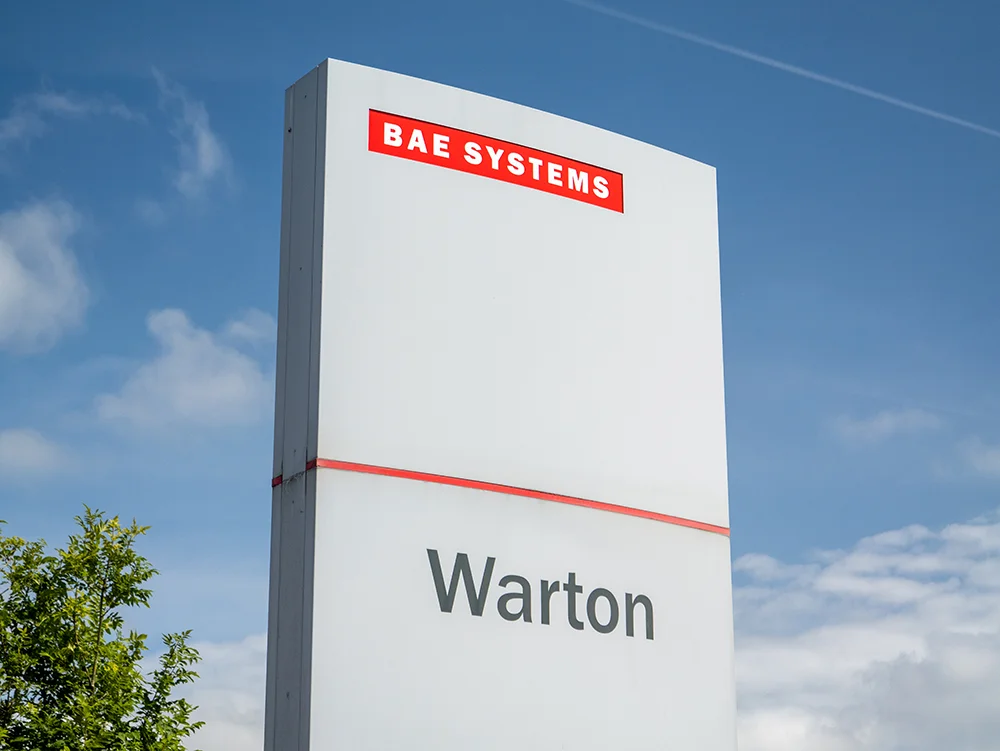
BAE entrance sign, July 2026 © Deeper Blue Marketing & Design Ltd
For more than eighty years, Warton Aerodrome has stood at the forefront of British aviation, evolving from a wartime airfield into one of the world’s leading centres for military aircraft design, development, testing and final assembly. Located on the Fylde Coast between Lytham St Annes and Preston, the site has played a pivotal role in British aerospace history, producing and testing many of the nation’s most iconic aircraft. Construction of the airfield began in May 1939, as tensions mounted across Europe before the outbreak of the Second World War. The British Air Ministry acquired farmland west of Preston to establish a satellite airfield for RAF Squires Gate in Blackpool. Runways were laid, drainage systems installed and support buildings constructed, creating what would soon become one of Britain’s most important military aviation sites.
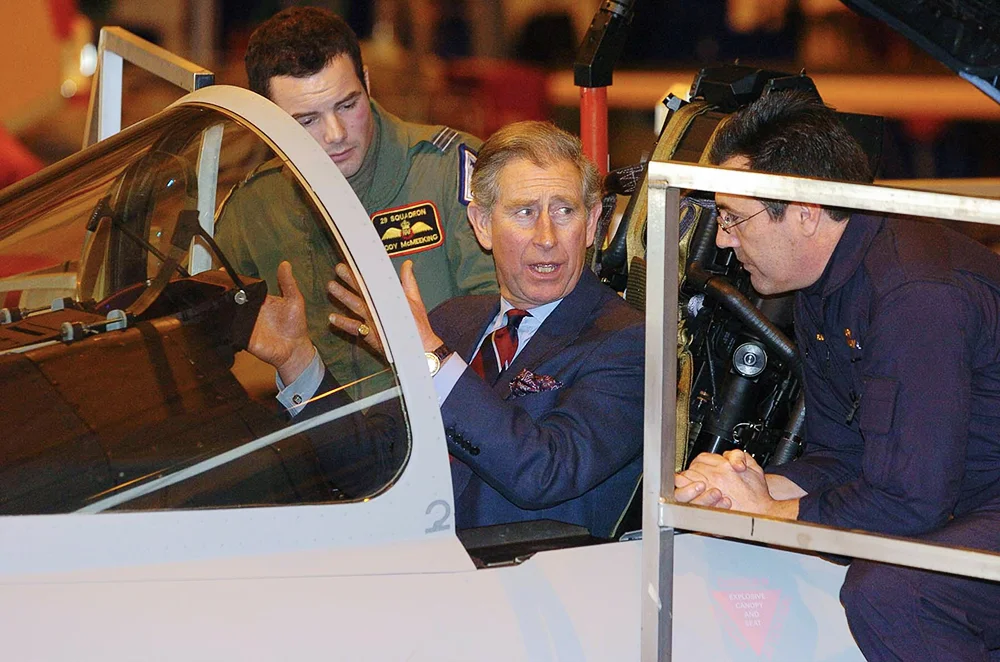
The Prince of Wales sits in the cockpit of a Eurofighter Typhoon during a tour of BAE Systems’ Warton Aerodrome, watched by Flight Lieutenant James McKeeking (Green Flight suit) and BAE Test pilot Mark Bowman, Wednesday 8 February 2006. PRESS ASSOCIATION Photo. Bruce Adams/Pool/PA. © Alamy
During the Second World War, Warton was transformed into Base Air Depot No. 2 (BAD2) for the United States Army Air Forces. Officially handed over in 1943, it became one of the largest American aircraft maintenance and modification centres outside the United States. More than 10,000 aircraft were assembled, repaired, modified or prepared for operational service at Warton, including thousands of B-24 Liberators and P-51 Mustangs destined for combat across Europe. At its peak, around 7,000 construction workers helped develop the extensive facilities required to support the American war effort. The airfield was also connected to one of Lancashire’s greatest wartime tragedies. On 23 August 1944, a USAAF B-24 Liberator attempting to land during severe weather crashed into the Holy Trinity School in nearby Freckleton, killing 61 people, including 38 children. The disaster remains one of the worst air accidents to occur on British soil and is closely associated with Warton’s wartime history.
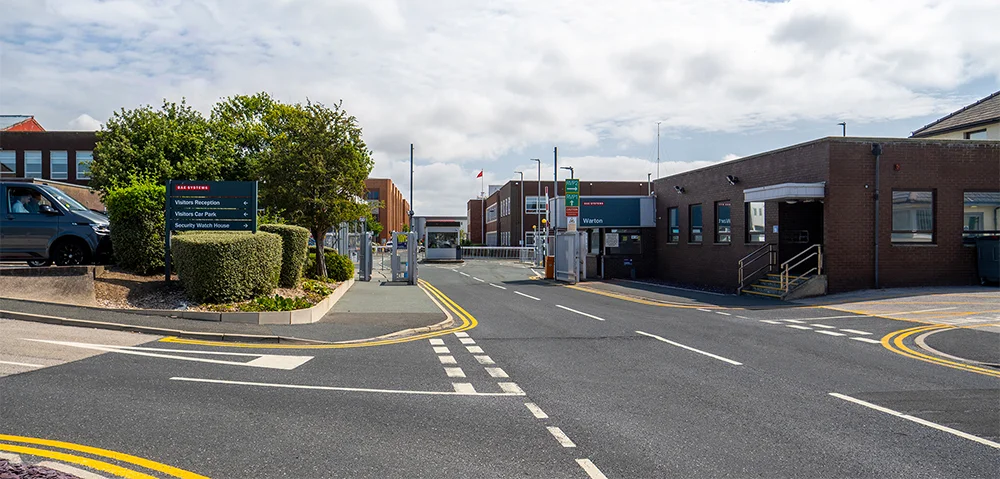
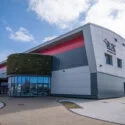
Entrance to BAE July 2026 © Deeper Blue Marketing & Design Ltd
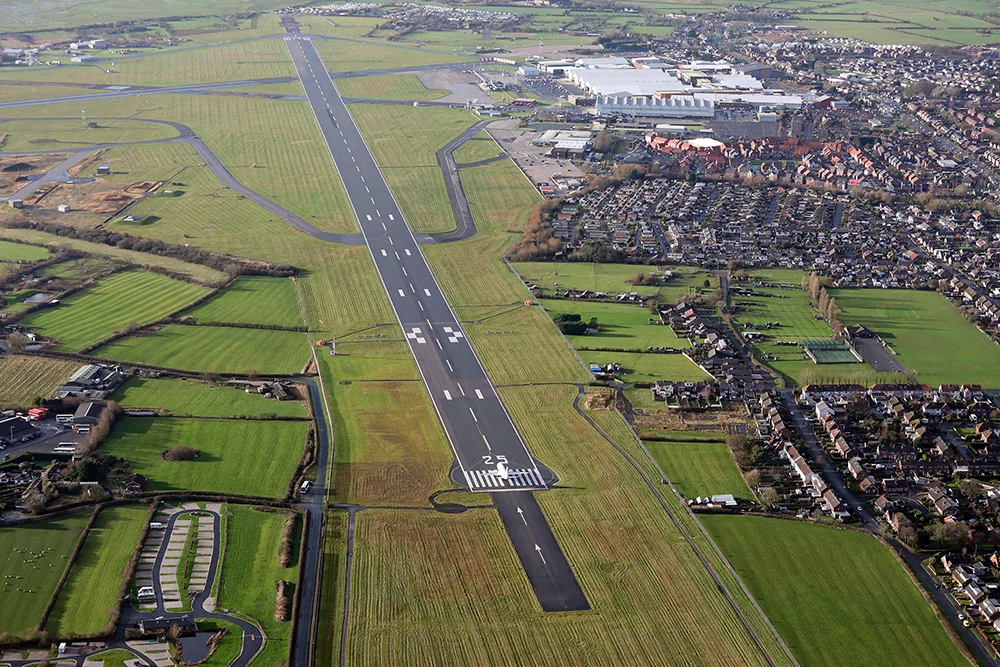
Aerial view of Warton aerodrome in Lancashire. © Alamy
Following the war, the American presence ended and control returned to the Air Ministry. In 1947, English Electric established operations at Warton, marking the beginning of a new era in British aircraft design. Engineers based at the site developed the revolutionary English Electric Canberra, Britain’s first jet-powered bomber, which made its maiden flight from Warton on 13 May 1949. The Canberra proved to be one of Britain’s most successful military aircraft, serving with the Royal Air Force for more than fifty years and being exported around the world. Warton continued to grow throughout the 1950s with the development of the English Electric Lightning, Britain’s first aircraft capable of sustained flight at twice the speed of sound. Extensive runway extensions, new wind tunnels and advanced testing facilities were constructed to support the programme, firmly establishing Warton as one of Europe’s premier aviation research centres.
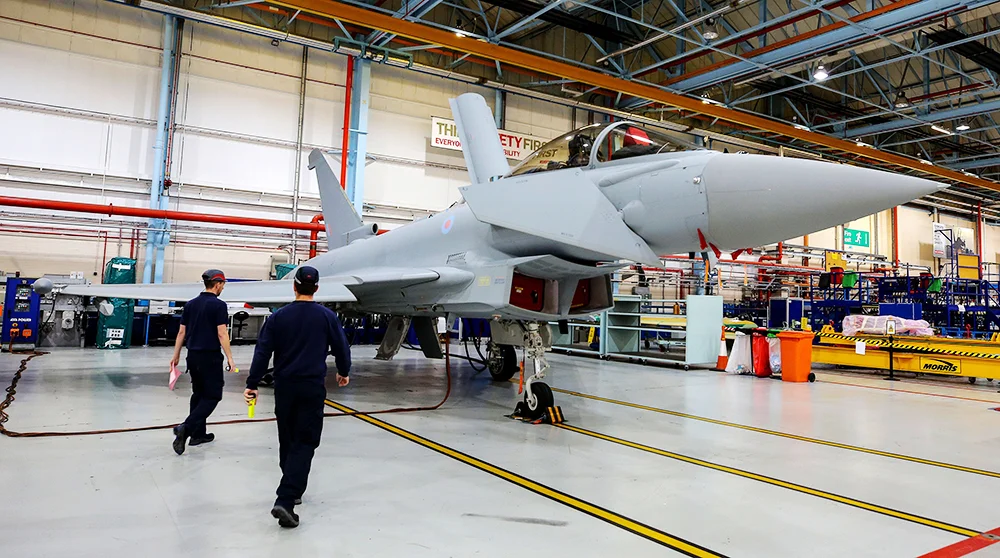
Staff assemble a Eurofighter Typhoon aircraft at BAE Warton in Lancashire, as BAE Systems has announced a contract valued at £5 billion to supply aircraft to Qatar, helping to secure jobs in the UK. © Alamy
The site remained at the heart of Britain’s aerospace industry as companies merged and evolved. English Electric became part of the British Aircraft Corporation (BAC) in 1960, before later becoming British Aerospace and, in 1999, BAE Systems. Throughout these changes, Warton continued to produce aircraft that shaped British military aviation, including the SEPECAT Jaguar, Panavia Tornado and BAE Hawk. The Tornado assembly hall, officially opened by Princess Anne in 1977, became one of the site’s defining landmarks. Perhaps Warton’s greatest modern achievement has been its contribution to the Eurofighter Typhoon. Development work began during the 1980s with the Experimental Aircraft Programme (EAP), which first flew from Warton in 1986. The knowledge gained from the EAP directly influenced the Eurofighter Typhoon, one of the world’s most advanced multi-role combat aircraft. Today, Warton remains responsible for final assembly, flight testing and ongoing upgrades to the Typhoon fleet, while also supporting the F-35 Lightning II programme.
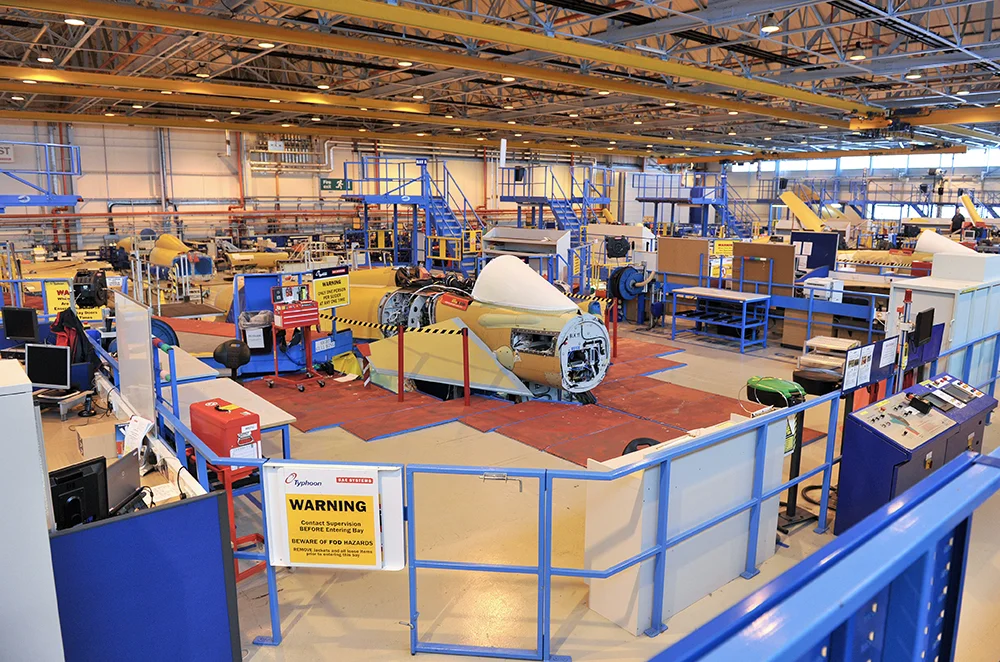
General View of the Eurofighter Typhoon hanger at BAE Systems in Warton, Lancashire. © Alamy
Looking to the future, Warton is a key partner in the Global Combat Air Programme (GCAP), an international collaboration between the United Kingdom, Italy and Japan to develop a sixth-generation combat aircraft due to enter service during the 2030s. The programme is expected to ensure that Warton remains at the forefront of aerospace innovation for decades to come, continuing a tradition of aircraft development that began before the Second World War. Today, BAE Systems’ Warton facility is recognised around the world as one of Britain’s most important aviation sites. From preparing thousands of Allied aircraft during the Second World War to developing supersonic fighters and the next generation of combat aircraft, its contribution to British engineering, defence and technological innovation has been immense. For the Fylde Coast, Warton has become far more than an airfield—it is a centre of scientific achievement, skilled employment and aerospace excellence that has helped shape the region’s identity for more than eight decades.
Background Image © Deeper Blue Marketing & Design Ltd


