























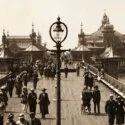


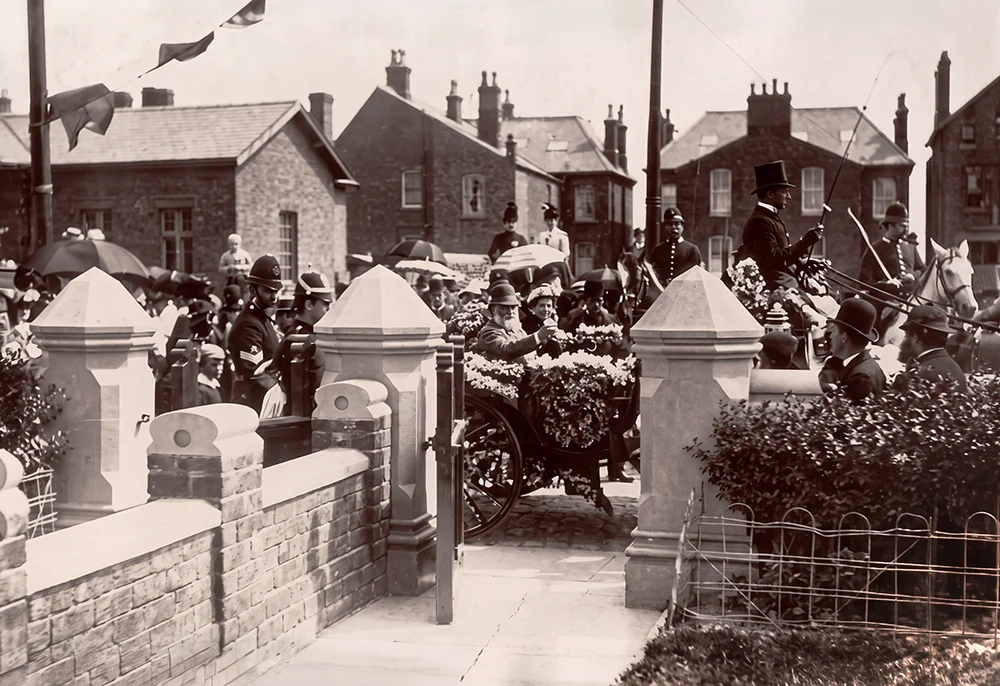
In September 1888, Blackpool’s Promenade became the setting for an unusual confrontation. Decorated carriages passed along the seafront, bands provided music, and spectators joined a celebration in which flowers became ammunition. The town’s first Grand Battle of the Flowers brought a continental carnival tradition to the Lancashire coast, although the exchanges proved considerably rougher than the elegant floral spectacle its organisers had envisaged.
The initiative was associated with Blackpool’s mayor, J. Fish, who sought to reproduce the flower festivals he had seen at Monte Carlo. Such celebrations combined elaborate carriage decorations with playful exchanges of flowers between participants and onlookers. For Blackpool, the Promenade provided a public stage on which a procession could become an attraction in its own right, bringing entertainment out into the streets.
Music formed an important part of the occasion. A history of the Salford Ironworks Brass Band records that it was one of six bands engaged for the event. The others included the Gloucester Regiment Band, Blackpool’s artillery volunteers and bands representing the Lytham and Preston Rifles. Their participation brought together civilian and military musicians, adding a ceremonial element to the floral festivities.
WATCH THIS NEW EXCLUSIVE AI VIDEO OF BLACKPOOL’S GRAND BATTLE OF THE FLOWERS
The flower throwing, however, became the event’s most memorable feature. Newspaper accounts described carriage occupants facing an increasingly vigorous bombardment, with cabbages and turnips joining the flowers. Participants suffered bruises, damaged hats and spoiled clothing, while some exchanges developed into scuffles. One report recalled a man standing in his carriage to protest at the crowd’s enthusiasm, only to be struck in the mouth by a bunch of asters. These accounts presented a lively and sometimes unruly spectacle in which the intended rules of the entertainment were quickly stretched.
Despite the disorder, the experiment was repeated. A second Battle of the Flowers took place in July 1889, with the procession extending from Lytham Road to Claremont Park. The event also became part of the town’s investment in attracting visitors: historical research records that profits from Blackpool’s municipal gas undertaking helped finance the parade and flower battles for several years from 1889.
The 1888 celebration belonged to a period when Blackpool was actively developing new ways to entertain its visitors. Its combination of decorated vehicles, live music and public participation illustrated how the seafront could serve as an open-air performance space. The Battle of the Flowers also revealed the unpredictability of that approach, as an imported display of floral elegance became a boisterous episode in the town’s Victorian entertainment history.
Featured Image © Blackpool Council/Planning Department Collection
Background Image © Alamy


