



































One of the largest modern infrastructure projects to affect the Fylde Coast was given government approval on 14 September 2026, following years of planning, consultation and increasingly organised local opposition. The Morgan and Morecambe Offshore Wind Farms Transmission Assets project is intended to carry electricity generated by two offshore wind developments in the Irish Sea into the National Grid. Although the turbines themselves will stand many miles offshore, the infrastructure required to connect them to the electricity network will cross a substantial part of the Fylde countryside. Cables will come ashore close to St Annes and Blackpool Airport, before travelling underground for approximately 25 kilometres through the borough towards Newton-with-Scales, eventually crossing the River Ribble and connecting with the existing National Grid substation at Penwortham. Two new electrical substations are also required in the area between Kirkham, Freckleton and Newton-with-Scales.
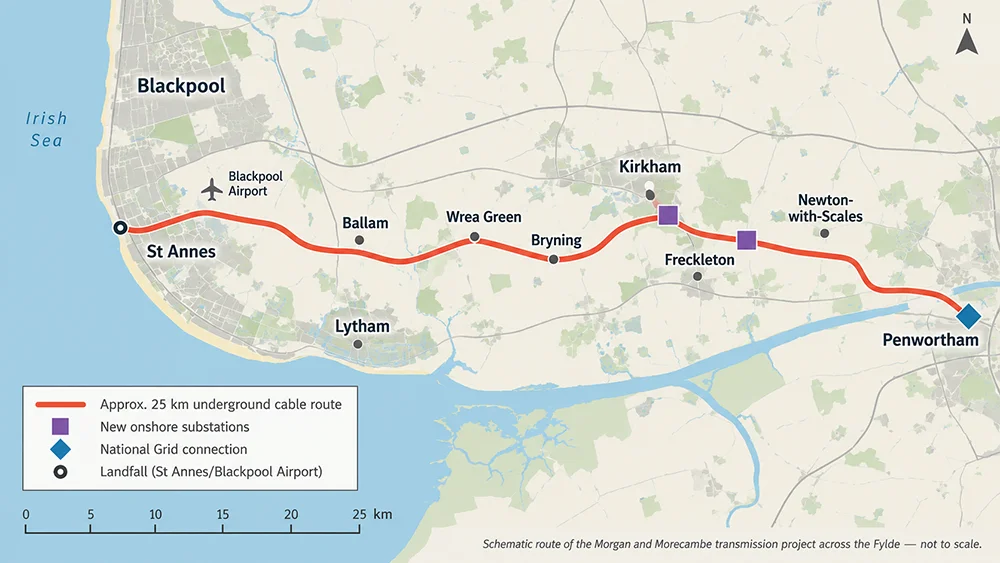 The scale of the development is perhaps easiest to appreciate on a map. From the landfall near St Annes, the route passes eastwards through predominantly agricultural countryside, close to communities including Ballam, Wrea Green and Bryning, before reaching the Kirkham, Freckleton and Newton area. The cables themselves will eventually be buried, with as many as 18 export cables installed for the two wind projects. Current construction information describes an onshore cable route of around 25 kilometres and a permanent underground corridor generally up to 70 metres wide, although wider areas are required at certain crossings. Temporary haul roads, construction compounds and working areas will be needed while the cables are installed. Earlier consultation designs allowed for a temporary corridor of up to around 120 metres, which helps explain some of the larger figures that have appeared during the campaign against the development.
It is important, however, to distinguish between the land affected during construction and what will remain permanently. Once the cables have been installed, the developers say temporary compounds and fencing will be removed, stored topsoil and subsoil replaced, field drainage reinstated and agricultural land restored to its original condition. Hedgerows are also intended to be replanted where practicable. The finished development will therefore not leave a continuous 70 or 100-metre-wide industrial strip across the Fylde. Much of the route should again appear as farmland with the cables buried beneath it. The two substations are different: they will be permanent above-ground developments, together with associated access and electrical infrastructure, and it is their effect on the open landscape and Green Belt that has become one of the most contentious parts of the scheme.
At the coast, special measures are proposed to reduce the impact on one of the area’s most sensitive landscapes. The offshore cables are intended to pass beneath the railway, A584 Clifton Drive North and the protected dunes of the Lytham St Annes Site of Special Scientific Interest, using horizontal directional drilling or another trenchless method rather than excavating an open trench through the dunes. Further inland, however, construction will inevitably involve considerable activity along the route, including excavation, construction traffic, temporary access tracks and compounds. Measures contained within the project’s construction plans are intended to control effects including noise, vibration, dust, surface water and pollution.
 Opposition has come from residents, parish councils, local authorities and the campaign group Fylde Against Cable Transmission and Substations (FACTS). Concerns have included the temporary loss and disturbance of farmland, wildlife and habitats, drainage and flooding, construction traffic and noise, as well as the permanent effect of the substations on the countryside. Campaign material has sometimes presented the entire construction footprint as land that will effectively be destroyed, whereas the developers emphasise that much of the cable corridor will be reinstated. There is nevertheless no dispute that construction represents a major intervention across a wide stretch of rural Fylde, nor that the substations will remain after the temporary works have disappeared.
The controversy is particularly interesting because opposition to the approved route has not simply been opposition to offshore wind. Lancashire County Council, Fylde Council and Wyre Council instead promoted an alternative northern connection involving Rossall, Stanah and the Hillhouse Technology & Energy Enterprise Zone at Thornton-Cleveleys. Their argument was that major electricity infrastructure could be concentrated around an area already associated with heavy industry and energy rather than requiring such an extensive route across agricultural land and new substations within the Fylde countryside. A review commissioned by the councils estimated that an alternative route for Morgan and Morecambe could potentially avoid around £287 million in infrastructure costs, rising to as much as £520 million if infrastructure for the proposed Mooir Vannin offshore wind project was also included. It additionally projected around 1,100 jobs associated with unlocking further development at Hillhouse and between £990 million and £1.7 billion of additional economic output between 2030 and 2040. These were projections from the councils’ commissioned economic review rather than guaranteed savings or employment figures.
Hillhouse presents an unusual contradiction of its own. The former ICI chemical complex is already an established industrial location and is designated for future technology and energy development, making it attractive to those who believe new infrastructure should be concentrated on or around existing industrial areas. At the same time, Hillhouse is currently the subject of a major investigation into historic PFOA/PFAS contamination arising from decades of chemical manufacture. That environmental legacy does not automatically prevent future energy development, but it adds another dimension to the debate over what Hillhouse should become following the decline of its traditional chemical industry.
The developers have maintained that a northern connection through Stanah and Hillhouse is not the straightforward alternative sometimes suggested. The existing National Grid connection at Penwortham was selected through the grid connection process, while a different northern route would require additional or expanded infrastructure and would introduce its own engineering and environmental constraints. In other words, moving the connection north would not simply remove the environmental impact; it would relocate it and change the nature of the infrastructure required. The central disagreement has therefore become one of which route creates the more acceptable balance between engineering requirements, environmental effects, cost and impact upon local communities.
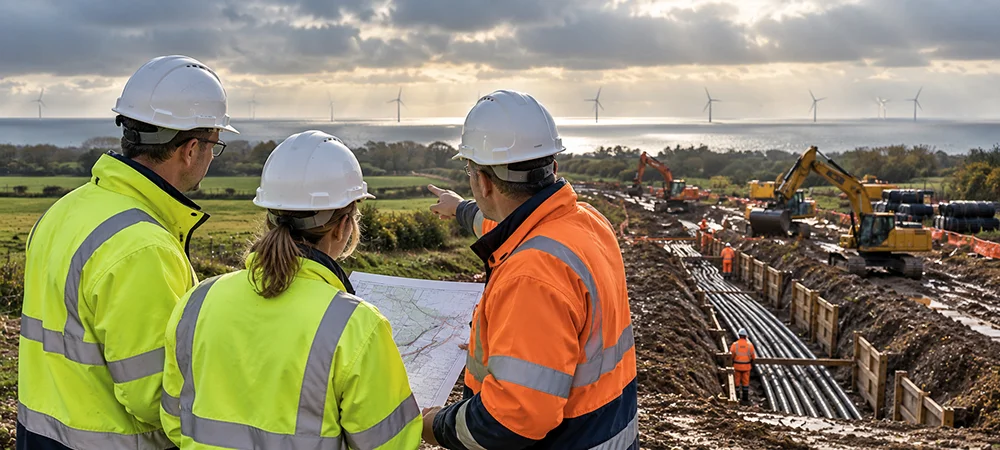
Artistic impression of engineers overseeing coastal cable works.
The planning process demonstrated how seriously those competing arguments were considered. The transmission application was submitted to the Planning Inspectorate on 21 October 2024 and accepted for examination the following month. A six-month examination allowed local residents, councils, statutory organisations and other interested parties to submit evidence, with the Examining Authority making its recommendation to the Secretary of State on 29 January 2026. Changes affecting the Morgan wind project during 2026 prompted the Lancashire councils to renew their call for the northern alternative to be reconsidered, while the Government delayed its final decision until September.
On 14 September 2026, development consent was granted for the transmission assets. The decision allows the offshore export cables, landfall infrastructure, underground onshore cables, two substations, grid connection cables and associated works to proceed subject to the requirements contained within the Development Consent Order. Fylde Council expressed deep disappointment and instructed legal advisers to examine the decision and its options, while Lancashire County Council said it was disappointed that the alternative connection promoted jointly with Fylde and Wyre had not been taken forward.
The Morgan and Morecambe controversy is therefore more complicated than a choice between renewable energy and protecting the countryside. Electricity generated far out in the Irish Sea has to reach the national transmission network somewhere, and any connection on this scale carries consequences. The approved solution takes that infrastructure from St Annes and Blackpool Airport, across the Fylde through the Ballam, Wrea Green and Bryning countryside and onwards towards Kirkham, Freckleton and Newton-with-Scales before eventually reaching Penwortham. Its opponents believe concentrating more of the infrastructure around the already industrialised Hillhouse and Stanah area would have caused less damage and potentially delivered greater economic benefits to Lancashire; the approved scheme reflects the conclusion that the Penwortham connection should proceed.
For the Fylde Coast, it represents another significant change to a landscape repeatedly reshaped by transport, industry and energy. Much of the cable route should eventually disappear beneath reinstated fields, but the substations and the debate surrounding their construction will remain. The argument has never really been about whether electricity from offshore wind needs to come ashore, but where the price of bringing it ashore should be paid.
For more information on ICI Hillhouse, check out Hillhouse and the Legacy of Forever Chemicals and ICI Hillhouse Starts Manufacturing Chemicals in Thornton-Cleveleys.
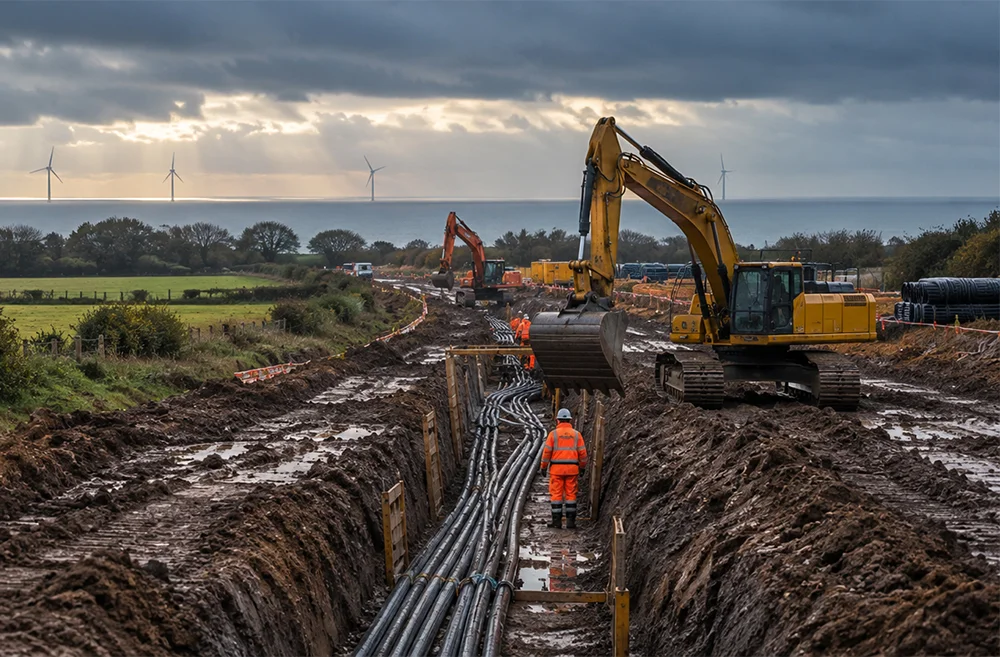
Artistic impression of what the site might look like in the future.


