





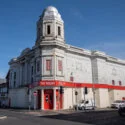









Harry Houdini’s association with Blackpool began in June 1905 when he arrived to headline a week-long engagement at the Hippodrome on Church Street. By this stage he had already established himself as one of the world’s most remarkable escape artists, but he understood that extraordinary publicity was just as important as extraordinary performances. Before stepping onto the Hippodrome stage, he arranged one of the most memorable demonstrations of his career by challenging Blackpool Police to confine him within one of their cells.
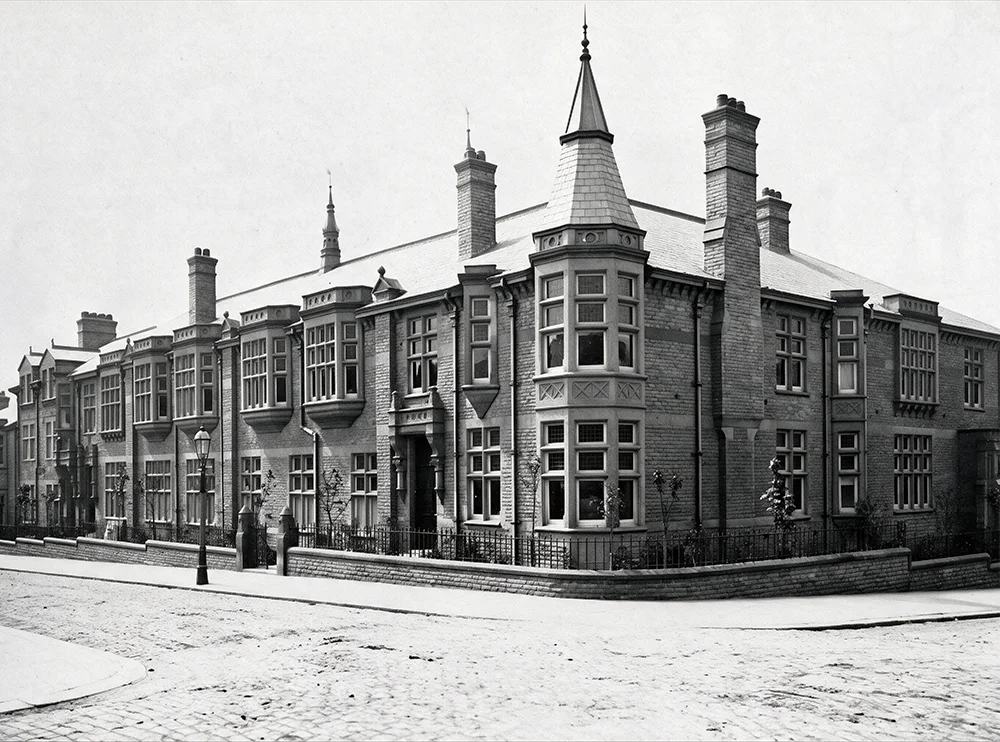
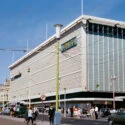
South King Street Police Station at the time
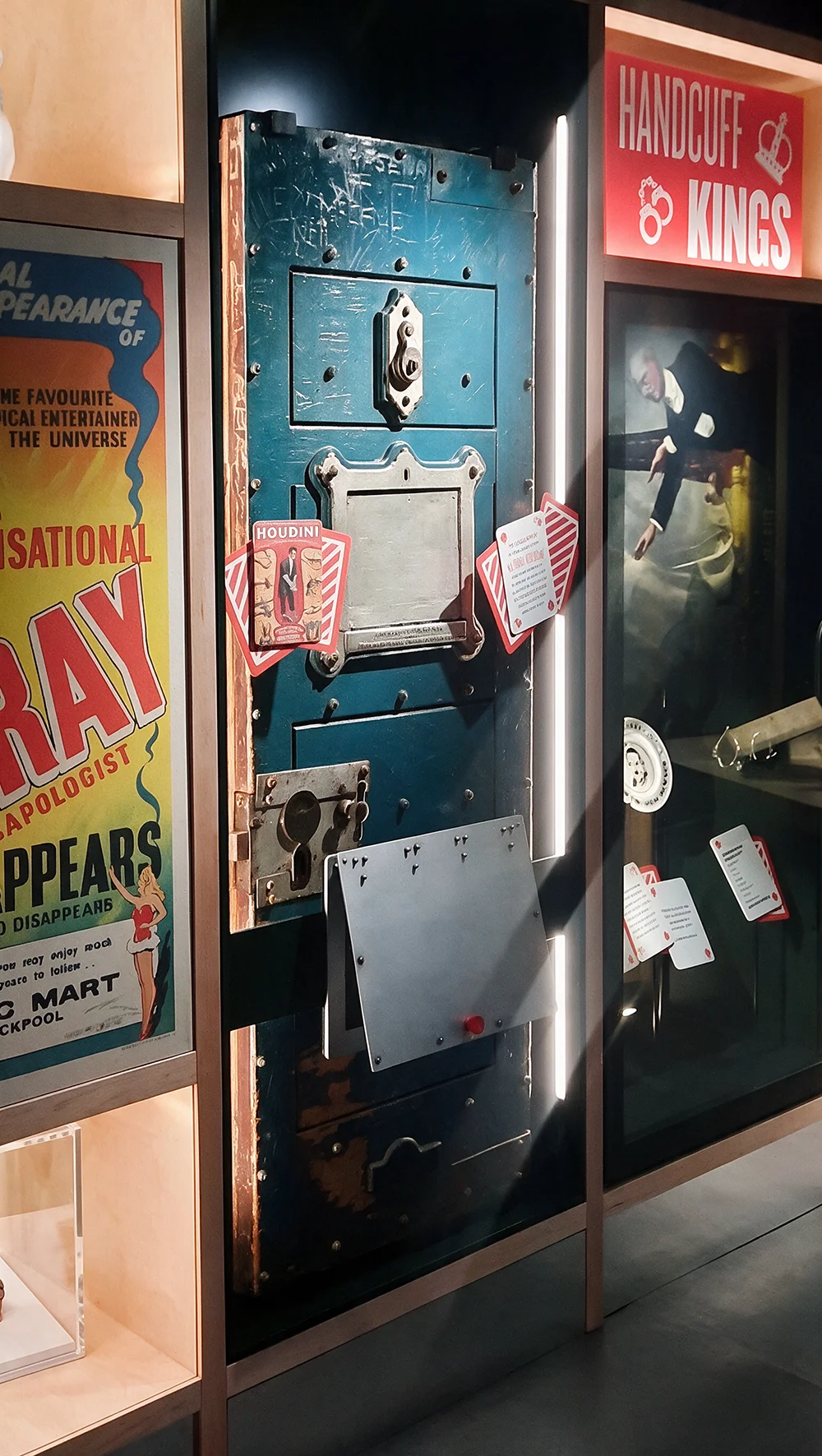
Showtown Cell Door. Photo by Karl Bartoni.
On 12 June 1905, Houdini was stripped and searched before being locked inside a cell at Blackpool Police Station under the supervision of Chief Constable John V. Hall and a gathering of councillors, former mayors and other local dignitaries. Within only a few minutes he had freed himself from the restraints, unlocked the cell door and emerged to the astonishment of those present. The feat was widely reported in the local and national press, providing the perfect introduction to his Blackpool engagement. More than a century later, the original police cell door has been preserved and is now displayed at Showtown Museum, where it remains one of the most significant surviving artefacts connected with Houdini’s visit to the resort.
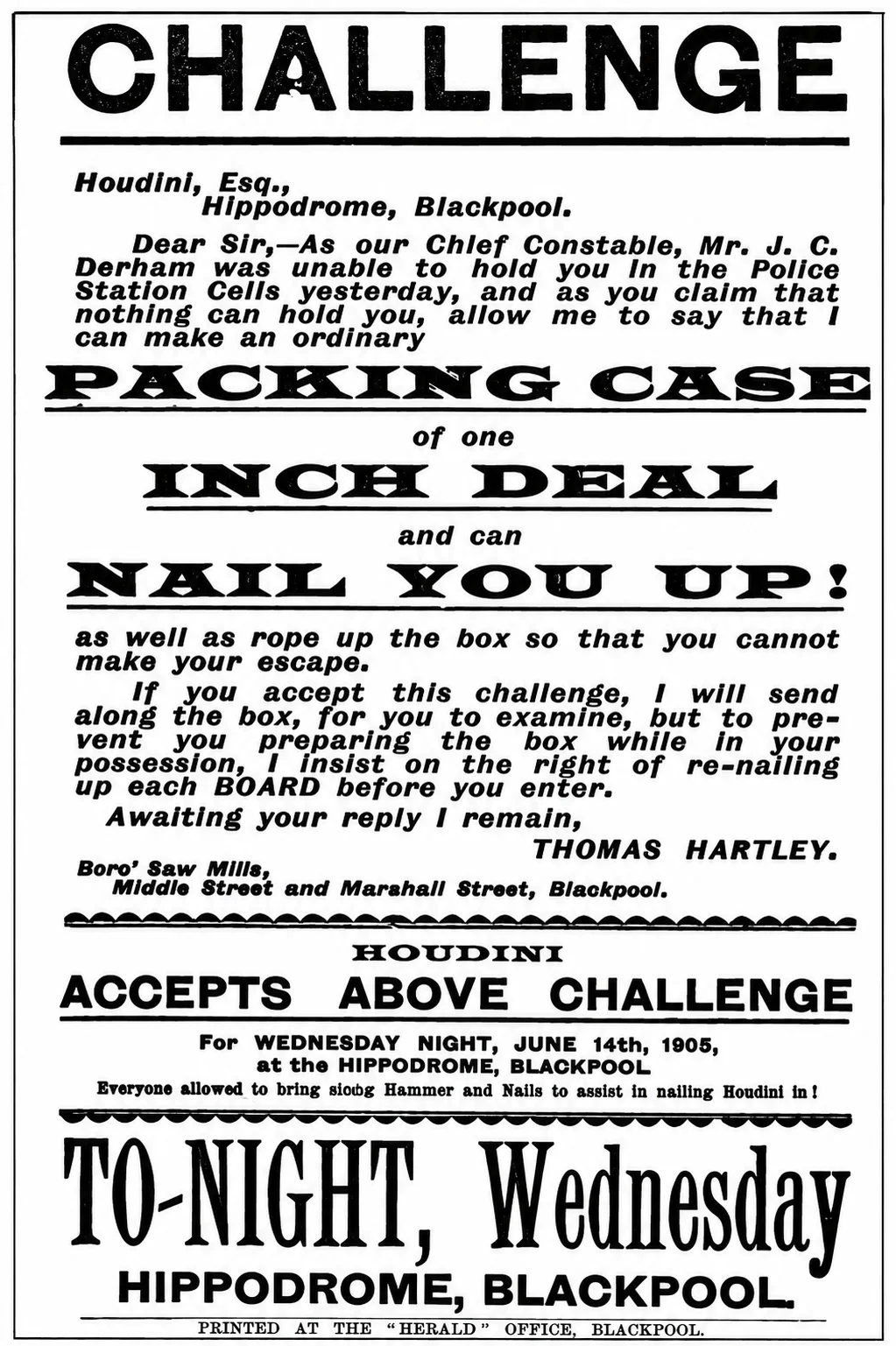
Houdini’s actual challenge
The excitement continued throughout the week at the Hippodrome. Local businesses were invited to devise challenges that they believed even Houdini could not overcome. One of the best known involved a specially constructed wooden packing case produced by a Blackpool firm. The challenge was advertised in advance, with the public invited to witness what many hoped would become the escape artist’s first defeat. Instead, Houdini once again demonstrated the skill that had made him internationally famous, escaping from the nailed and secured case before a captivated audience and reinforcing his reputation as the greatest escapologist of his generation.
Houdini’s visit marked one of the earliest occasions on which Blackpool became associated with the world of stage magic. His combination of daring publicity stunts, technical brilliance and theatrical showmanship helped establish a tradition that would continue to flourish in the resort throughout the twentieth century, eventually earning Blackpool its reputation as one of Britain’s leading homes of magic and variety entertainment.
THE TEXT AND IMAGES BELOW REFER TO HOUDINI’S ACTS PERFORMED ELSEWHERE, EITHER IN EUROPE OR THE US.
Chinese water torture cell
Around 1912, the vast number of imitators prompted Houdini to replace his milk can act with the Chinese water torture cell. In this escape, Houdini’s feet were locked in stocks, and he was lowered upside down into a tank filled with water. The mahogany and metal cell featured a glass front, through which audiences could clearly see Houdini. The stocks were locked to the top of the cell, and a curtain concealed his escape. In the earliest version of the torture cell, a metal cage was lowered into the cell, and Houdini was enclosed inside that. While making the escape more difficult – the cage prevented Houdini from turning – the cage bars also offered protection should the front glass break.
The original cell was built in England, where Houdini first performed the escape for an audience of one person as part of a one-act play he called “Houdini Upside Down”. This was done to obtain copyright protection for the effect, and establish grounds to sue imitators – which he did. While the escape was advertised as “The Chinese Water Torture Cell” or “The Water Torture Cell”, Houdini always referred to it as “the Upside Down” or “USD”. The first public performance of the USD was at the Circus Busch in Berlin, on September 21, 1912. Houdini continued to perform the escape until his death in 1926.
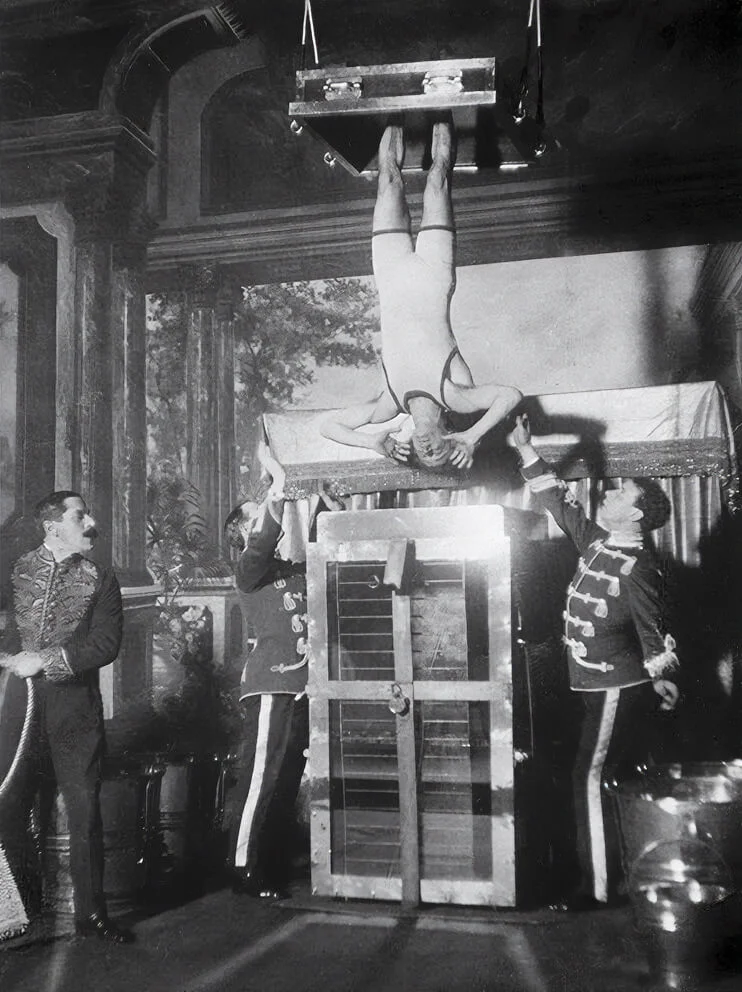
Houdini performing the Chinese Water Torture Cell, circa 1913
From 1907 and throughout the 1910s, Houdini performed with great success in the United States. He freed himself from jails, handcuffs, chains, ropes, and straitjackets, often while hanging from a rope in sight of street audiences. Because of imitators, Houdini put his “handcuff act” behind him on January 25, 1908, and began escaping from a locked, water-filled milk can. The possibility of failure and death thrilled his audiences. Houdini also expanded his repertoire with his escape challenge act, in which he invited the public to devise contraptions to hold him. These included nailed packing crates (sometimes lowered into water), riveted boilers, wet sheets, mail bags, and even the belly of a whale that had washed ashore in Boston. Brewers in Scranton, Pennsylvania, and other cities challenged Houdini to escape from a barrel after they filled it with beer.
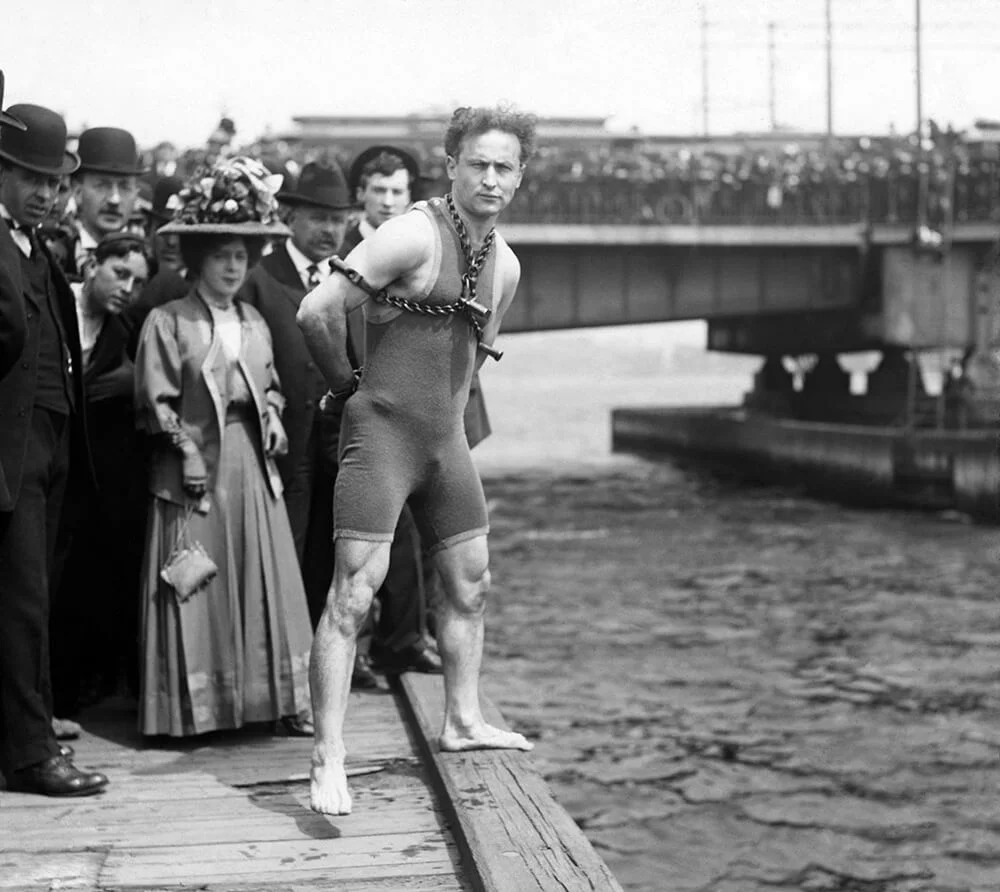
Harry Houdini jumps from Harvard Bridge,Boston, Massachusetts, 1908 -John H. Thurston, stereopticons LCCN2015650990 – restoration
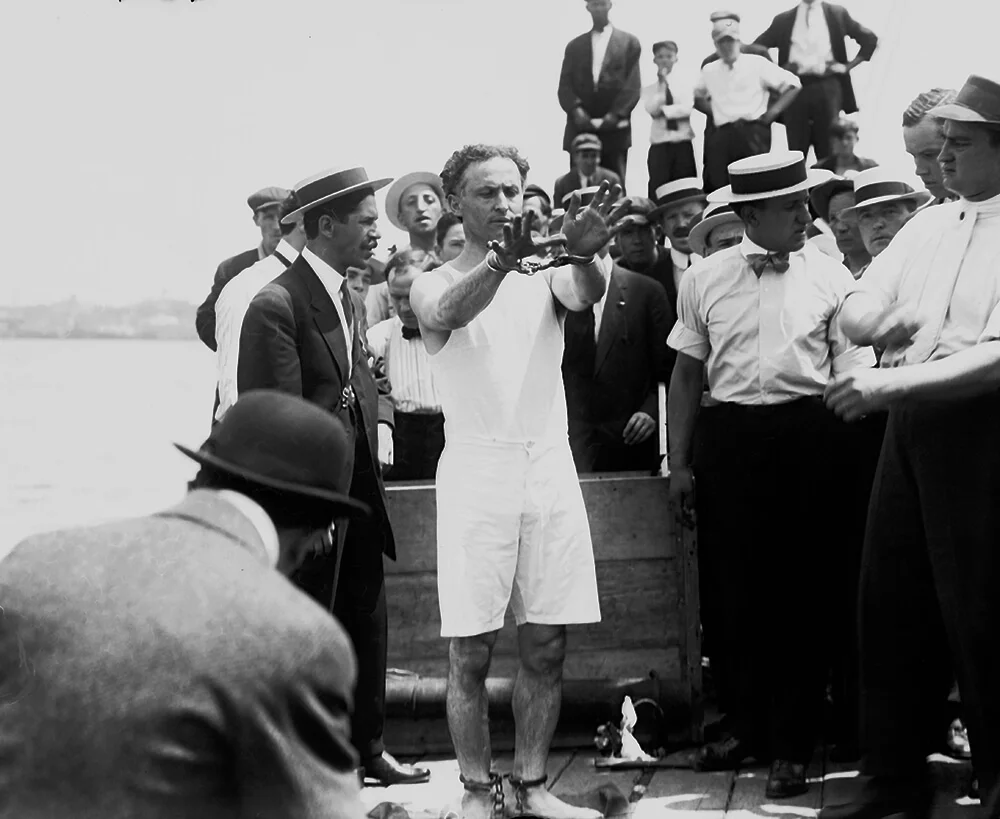
Houdini Submerged Crate – Houdini prepares to do the overboard box escape c. 1912
Aviation
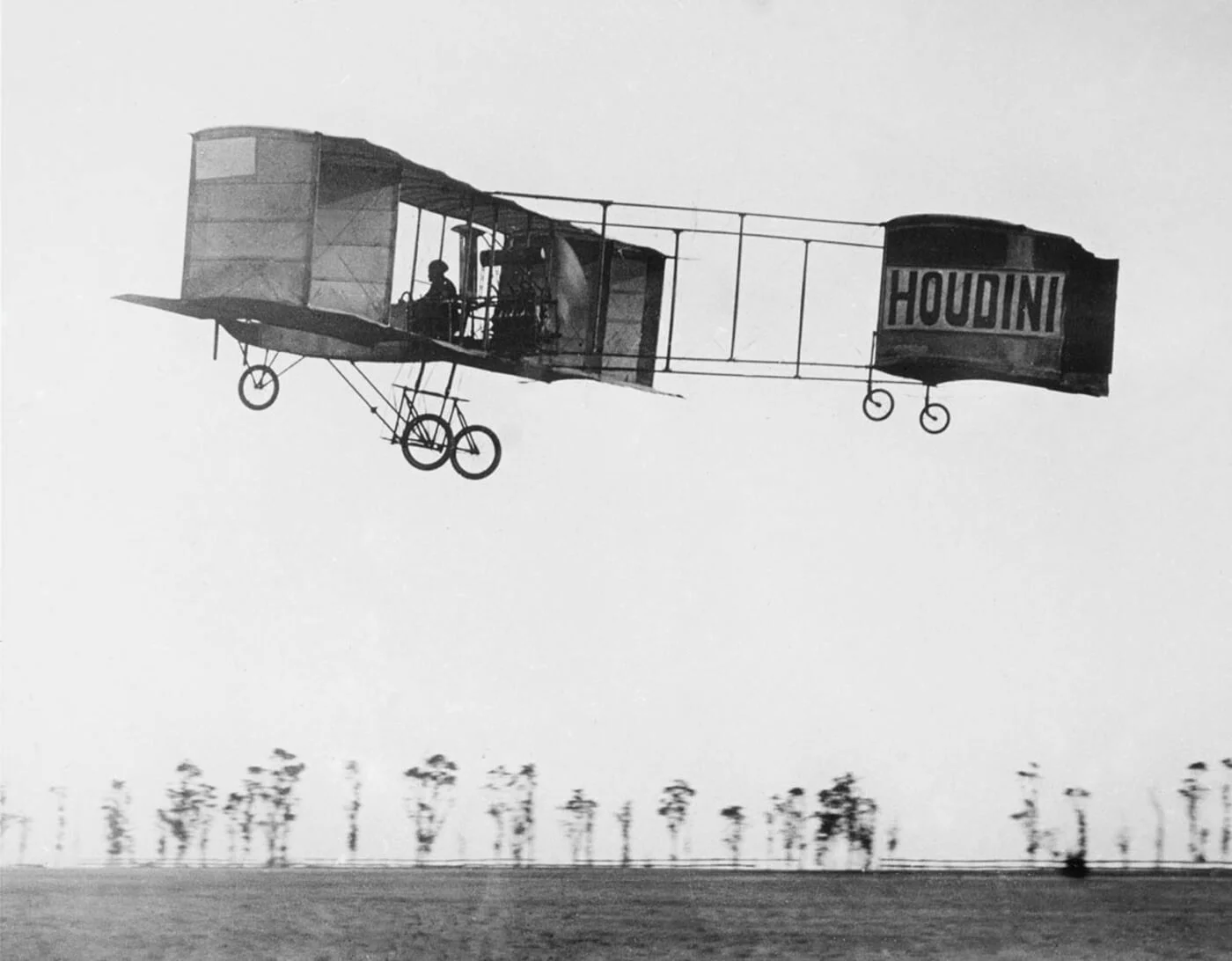
Houdini airborne in his Voisin at Diggers Rest, Victoria, Australia, 1910 – photographer Marcel Poupe
In 1909, Houdini became fascinated with aviation. He purchased a French Voisin biplane for $5,000 (equivalent to $168,732 in 2024) from the Chilean aviators José Luis Sánchez-Besa [fr] and Emilio Eduardo Bello, and hired a full-time mechanic, Antonio Brassac. After crashing once, he made his first successful flight on November 26 in Hamburg, Germany. The following year, Houdini toured Australia and brought along his Voisin biplane with the intention to be the first person to fly in Australia.
Australian flights
On Friday, March 18, 1910, following more than a month of delays due to inclement weather conditions, Houdini completed one of the first powered aeroplane flights ever made in Australia. He made three flights in his French Voisin biplane, at the Old Plumpton Paddock, at Diggers Rest, Victoria, ranging from 1 minute to 3½ minutes – reaching an altitude of 100 ft in one of his flights, and travelling more than two miles in another. Nine of the 30 spectators present on that day signed a certificate verifying Houdini’s achievement.
Hampered by the windy conditions on the Saturday, and unable to fly safely, Houdini took to the air again early on Sunday morning, 20 March 20, 1910: After a short preliminary flight, lasting 26 sec., Houdini took wing again, and, amid loud applause from the hundred or more spectators, who were on the ground, described three circles at altitudes, varying from 20ft to over 100ft, covering a distance of between three and four miles in 3min 45½sec. The Argus, 21 March 1910.
On Monday morning, 21 March 1910, some 30 spectators witnessed Houdini make an extended flight at Diggers Rest of 7min. 37secs., covering at least 6 miles, at altitudes ranging from 20 ft. to 100 ft. Australian aviator Basil Watson’s father, mother, and younger sister, Venora, were among the spectators; and their names were included in the list of 16 spectator signatures on the certificate that verified Houdini’s achievement.
After Australia
After completing his Australia tour, Houdini put the Voisin into storage in England. He announced he would use it to fly from city to city during his next music hall tour and even promised to leap from it handcuffed, but he never flew again.
You can see more about Houdini by going to the Showtown Museum page on this website.
Filmography
• Merveilleux Exploits du Célébre Houdini à Paris – Cinema Lux (1909) – playing himself
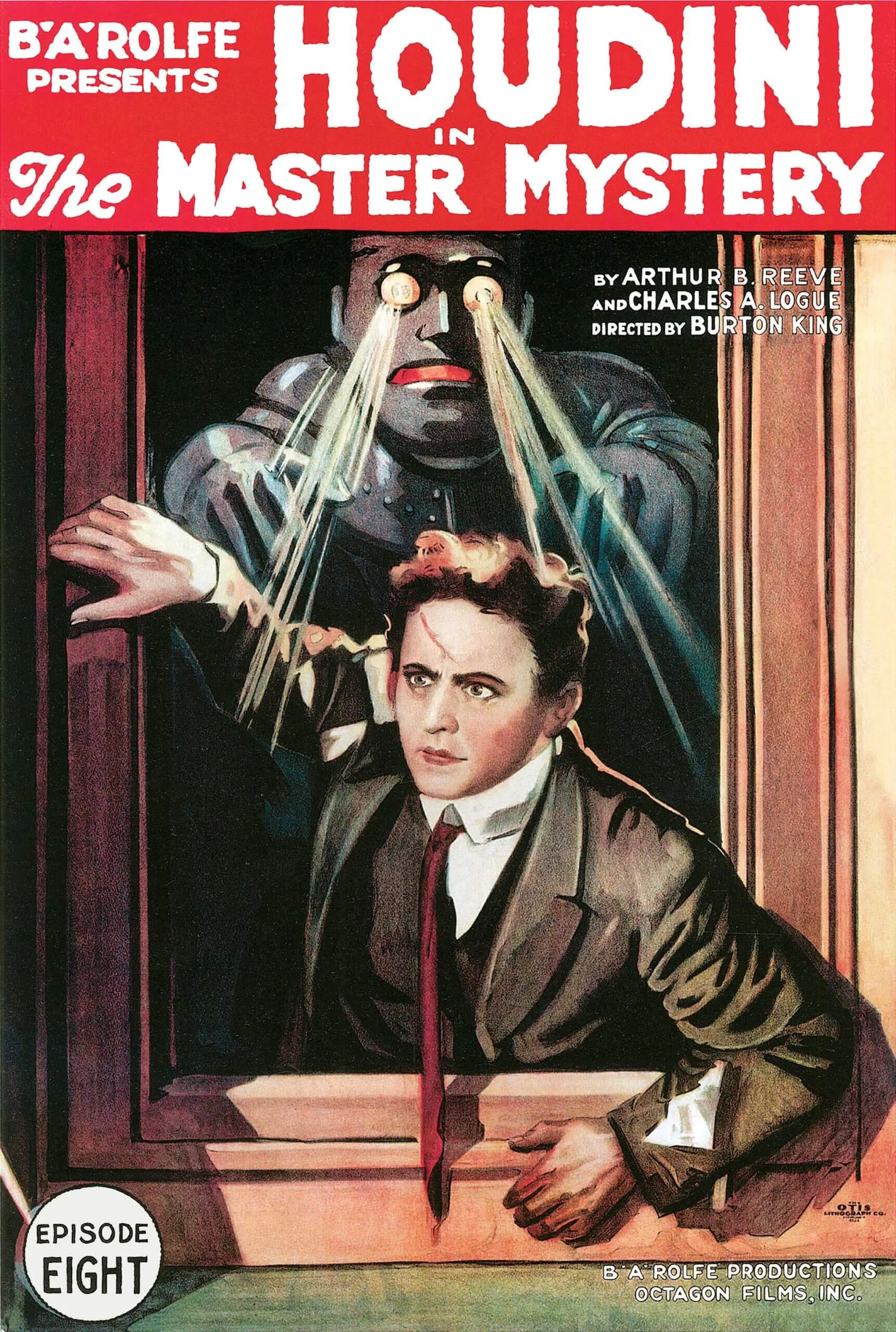
The Master Mystery – Octagon Films (1918) – playing Quentin Locke
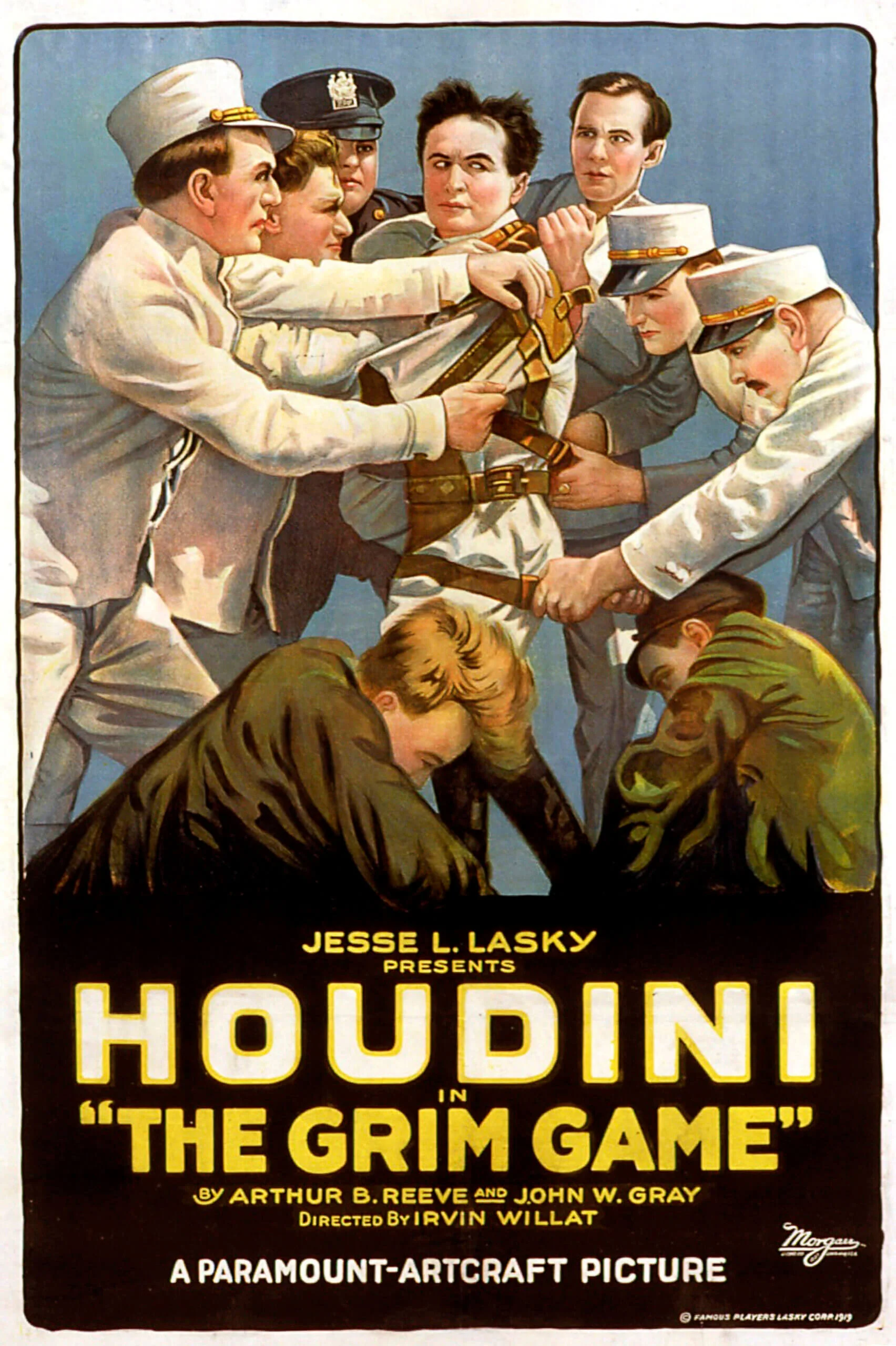
The Grim Game – Famous Players–Lasky/Paramount Pictures (1919) – playing Harvey Handford
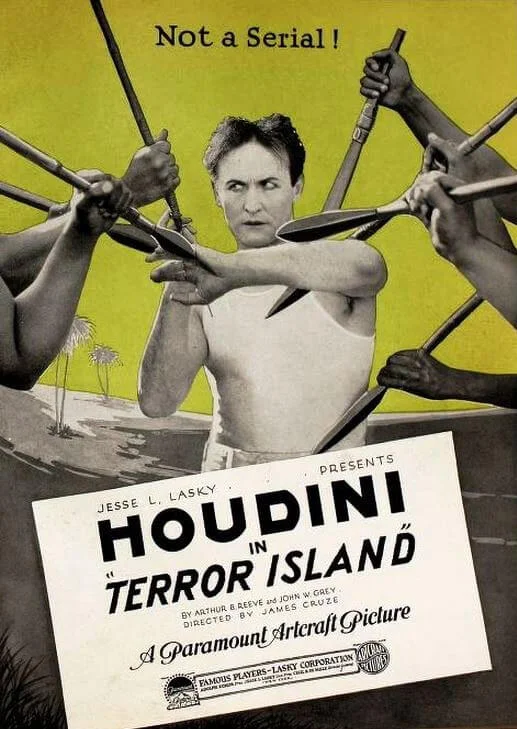
Terror Island – Famous Players Lasky/Paramount (1920) – playing Harry Harper
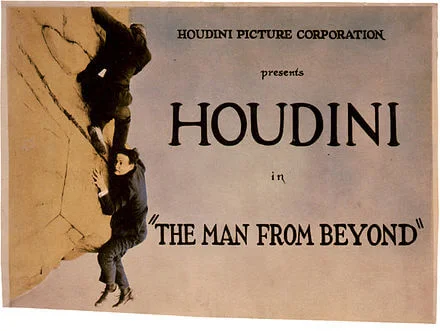
The Man from Beyond – Houdini Picture Corporation (1922) – playing Howard Hillary
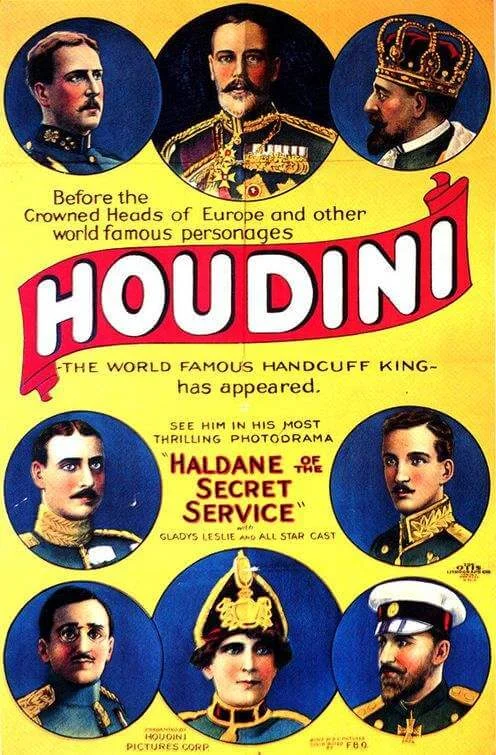
Haldane of the Secret Service – Houdini Picture Corporation/FBO (1923) – playing Heath Haldane
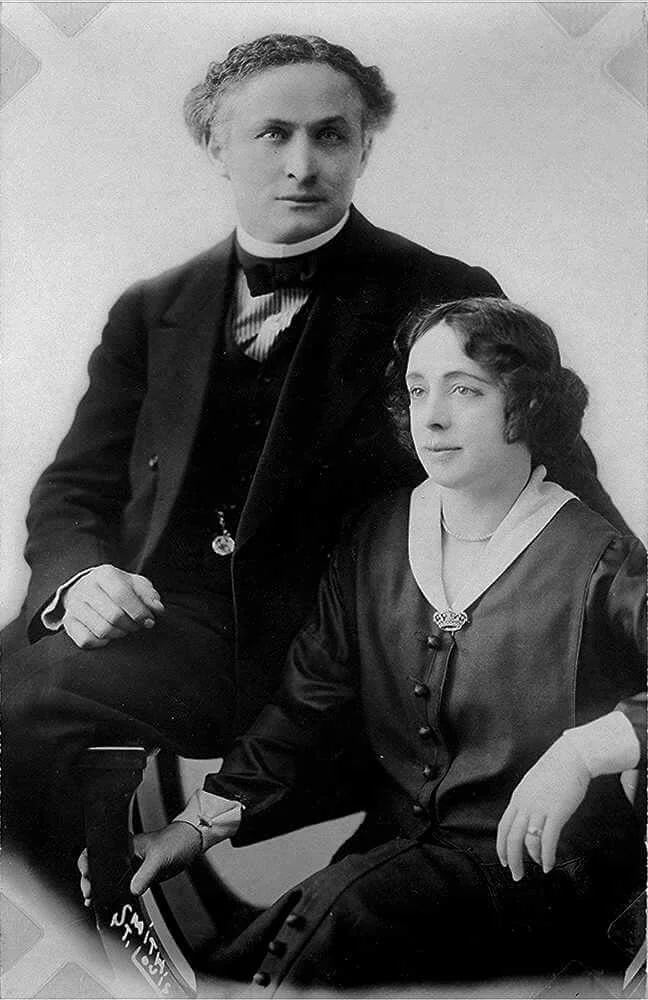
Harry Houdini and his wife – photographer Smith, St. Louis; McManus-Young Collection
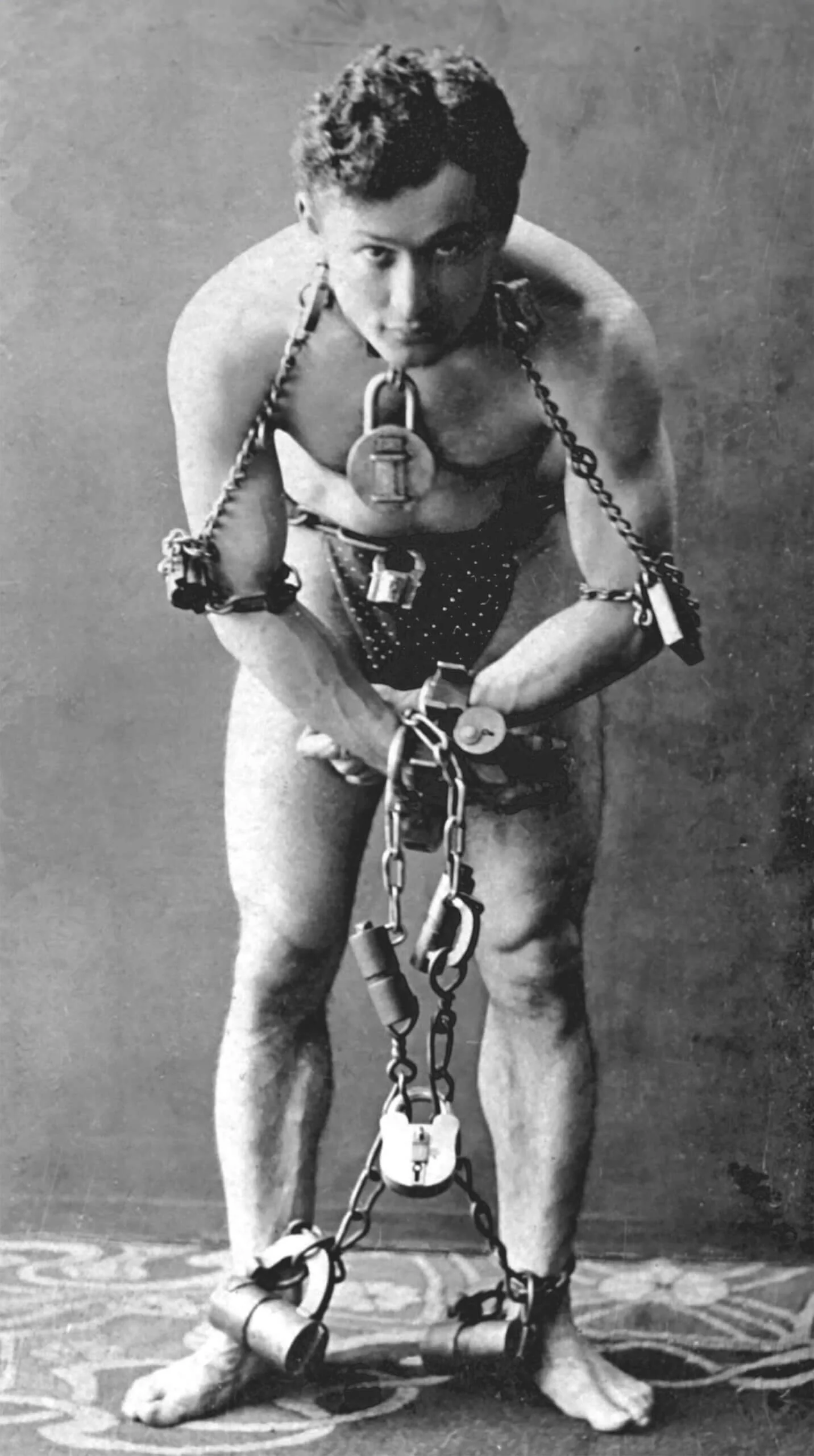
Houdini in a publicity shoot wearing chains and padlocks, 1899
Featured Image © Alamy
Background Image © Deeper Blue (Taken at Showtown Museum)


