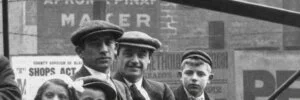

Long before the era of luxury coaches and family cars, the charabanc transformed the way people explored the Fylde Coast. These open-sided motor vehicles became one of the defining sights of the early twentieth century, carrying thousands of day-trippers from Lancashire’s mill towns to Blackpool, Fleetwood, Lytham St Annes and the surrounding villages. For many working-class families, a charabanc excursion provided their first opportunity to enjoy a day beside the sea. The word charabanc originated from the French char à bancs, meaning “wagon with benches”. Early charabancs were little more than motorised wagons fitted with rows of wooden seats and…
Category: 1900
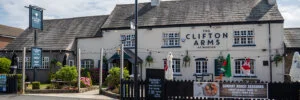
History of The Clifton Arms in Warton
Standing on Lytham Road at the heart of Warton, The Clifton Arms has served the village for well over a century, becoming one of its best-known public houses. Throughout its history it has welcomed local residents, agricultural workers, military personnel, employees from the neighbouring airfield and generations of visitors, reflecting the changing character of Warton as it evolved from a rural farming community into an internationally recognised centre of aviation. The earliest known photographs show the building operating as the Clifton Arms Hotel around 1900. At that time Warton remained a quiet agricultural village surrounded by farmland, and inns such…
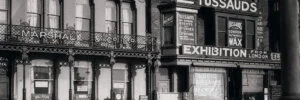
Louis Tussaud’s Waxworks: Bringing the Famous to Blackpool
For more than a century, Louis Tussaud’s Waxworks has been part of Blackpool’s entertainment story, allowing visitors to stand face to face with royalty, world leaders, sporting heroes, film stars and historical figures. While many people associate wax museums with Madame Tussauds in London, Blackpool has its own remarkable connection to the famous Tussaud family that dates back to the very beginning of the twentieth century. Louis Joseph Kenny Tussaud was born in 1890 and was the great-grandson of the renowned wax modeller Madame Marie Tussaud, whose London exhibition had already become internationally famous. Determined to establish his own reputation,…
King Edward VII Visited The River Wyre Hotel
Set back from the main roads of Poulton-le-Fylde, close to the slow curve of the estuary, The River Wyre occupies a landscape that has long attracted travellers, sportsmen, and those seeking refuge from the formality of towns and cities. In the late nineteenth and early twentieth centuries, this quiet stretch of Lancashire was fashionable in a way that now feels distant — valued for fresh air, shooting estates, fishing, and the privacy offered by its flat, open horizons. It was within this context that King Edward VII, then Prince of Wales, is said to have visited the River Wyre during…
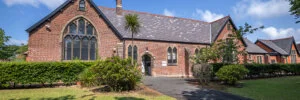
Sir John Alcock Attends Heyhouses Endowed Church of England School
Captain Sir John William Alcock KBE DSC (5 November 1892 – 19 December 1919) was a British Royal Navy and later Royal Air Force officer who, with navigator Lieutenant Arthur Whitten Brown, piloted the first non-stop transatlantic flight from St. John’s, Newfoundland to Clifden, Ireland in June 1919. He died in a flying accident in France in December later that same year. Portrait of Captain Sir John William Alcock. Circa 1919 John Alcock was born on 5 November 1892, perhaps in the coach-house adjoining Basford House on Seymour Grove, Firswood, Manchester, England. His family lived for eight years in Lytham….
Home of the UK’s First Purpose-Built Cinema
Blackpool’s first purpose-built cinema, the Tower Cinema, opened in 1900 and holds a special place in the history of cinema in the UK. Located inside the iconic Blackpool Tower, it was designed specifically to cater to the growing demand for motion pictures, a new form of entertainment that was rapidly gaining popularity at the time. The Tower Cinema was significant for several reasons. While films had been shown in various venues before, such as fairgrounds, music halls, and temporary spaces, the Tower Cinema was the first to be built exclusively for the exhibition of films. This made it one of…
Blackpool Town Hall
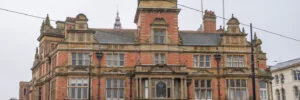
The current Blackpool Town Hall was built to replace an earlier 18th-century structure, which had been located just south of its present site, near the old St John’s Market. Designed by Potts, Son, and Hennings in a Jacobean style, the new building was completed in 1900 and stands on Talbot Square. The façade features a balanced design with seven bays, the outermost ones curving gracefully around the sides. At the centre is a prominent five-stage clock tower, with the ground floor portico supported by Tuscan-style pilasters, while the first floor is distinguished by Ionic columns, a segmental pediment, and a… Read more »