





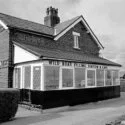










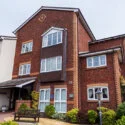

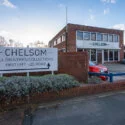







John Charles Robinson was a prominent architect in Blackpool, serving as the Borough Architect from 1920 to 1944. He designed numerous iconic civic buildings, including schools, libraries, and recreational facilities. Blackpool Council has a new project on Church Street that bears his name. Here is a list of some of the buildings that have benefitted from John Charles Robinson: The shelter, Devonshire Square Citadel 1924 Memorial Hall Colonade, Blackpool promenade Blackpool Zoo Harrowside Pool and Bridge North Shore Lift Layton Square Toilet block Stanley Buildings Carleton Crematorium Gatehouse and Chapel Little Bispham Tram Shelter Blackpool Cricket Club Stanley Park Golf…

Author: Ed
Alistair Cooke Gets a Firm Footing From Blackpool
Alistair Cooke, KBE (born Alfred Cooke on 20 November 1908, died 30 March 2004), was a British-American journalist, author, and broadcaster whose career flourished mainly in the United States. He became best known for Letter from America and America: A Personal History of the United States, and for presenting PBS’s Masterpiece Theatre from 1971 to 1992. His calm, intelligent delivery and distinctive voice made him one of the most recognisable broadcasters of his time. Even after retiring from television following more than four decades in broadcasting, he continued recording Letter from America until shortly before his death. Cooke was born…
The Foxhall’s Humble Beginnings, Now a Ma Kellys
THE FOXHALL Fox Hall stood as one of the earliest known residences in what would later become Blackpool. It was built in the latter part of the 17th century by Edward Tyldesley (1635–1685), most likely around 1670. Edward’s son, Thomas Tyldesley (1657–1714), occupied the house during the years covered by his surviving diary, which remains a valuable record of Lancashire life in the late Stuart period. At the time, Blackpool was little more than a stretch of windswept coastline, remote and sparsely inhabited. The Tyldesleys’ decision to build there has long been thought deliberate — a choice of seclusion that…
Cornelius Bagot Moves Back to Blackpool
Cornelius Bagot was born in Blackpool on 15 February 1838, the son of C. Bagot, Esq., a respected yeoman who served for more than forty years as the town’s Honorary Overseer. Educated first at Marton Grammar School under the Rev. Joseph Bryers, M.A., and later at Rogers’ School in Blackpool, Bagot demonstrated early promise in his academic and technical studies. He served a full apprenticeship with William Stones of Blackburn, gaining a thorough foundation in architectural practice. Following this, he spent over thirty years in Manchester, working with several leading figures in the profession, including Peter Bradshaw Alley, architect and…
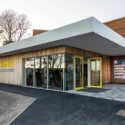
Stanley Park Visitors Centre
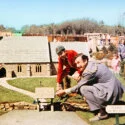
The Stanley Park Visitor Centre opens its doors on 24 August 2005. The ceremony is led by Edward Richard William Stanley, the 19th Earl of Derby, who cuts the ribbon and formally inaugurates the new facility. The centre is funded by the National Lottery and provides a permanent base for the Friends of Stanley Park, the volunteer group who now manage the building. Constructed on the footprint of an old, disused joinery workshop, the centre is staffed by volunteers and serves as both an information point and a hub for community engagement. The visitor centre continues the connection between Blackpool…
Harold Larwood – From Cricket to Sweets & Tobacco
Harold Larwood, a celebrated English cricketer, had a connection to Blackpool after his first-class cricket career with Nottinghamshire ended. He played for Blackpool Cricket Club in 1939. On the outbreak of war, Larwood left the game altogether, to work away from the public eye as a market gardener. In 1946 he used his savings to buy a sweet shop on Caunce Street in Blackpool. A park in Victory Road, Blackpool, was renamed in his honour. Harold Larwood Park © Deeper Blue Marketing & Design Harold Larwood Park © Deeper Blue Marketing & Design Harold Larwood Park © Deeper Blue Marketing…
The Legacy of the Gynn Pub & Restaurant
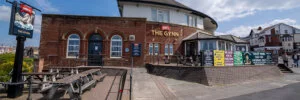
The Gynn Inn is remembered as one of Blackpool’s earliest and most significant hostelries, its story beginning in 1715. At first it stands as a modest farmhouse, typical of the Fylde coast’s rural landscape. Over time the building adapts, serving as a grocer’s and beerhouse before gaining full recognition as a public house. By the 18th and 19th centuries it becomes an established stop for both locals and travellers, a place of refreshment at a time when Blackpool is only beginning its transformation from scattered hamlets into a seaside resort. The inn gains particular importance because of its position on…
Amy Johnson’s Final Flight From Blackpool Airport
On the evening of 4 January 1941, Amy Johnson CBE, one of Britain’s most celebrated aviators, spends time in Blackpool. She visits her sister Mollie, who lives on Newton Drive, a residential street not far from the town centre. Johnson has stayed with her sister before, and Blackpool serves as a familiar waypoint during her service with the Air Transport Auxiliary (ATA). Click here to see more information on her previous visits. The following day she departs from RAF Squires Gate, now Blackpool Airport, piloting an Airspeed Oxford on a ferry flight from Prestwick to RAF Kidlington near Oxford. Weather…
The Steady Growth of Melrose Investments
Melrose Investments was established in 1998 by Chris Chadwick in Marsh Mill Village, Thornton Cleveleys. His brother Andy was also very successful while running Chadwicks Timber, which was sold in 2005 to Saint-Gobain, a global construction materials leader, and now trades under the name of Jewson. Melrose Investments has a very successful track record of developing and investing in property across the North West of England for over 25 years. From their early beginnings as a residential developer, they are now concentrated on residential and commercial investment. Their commercial offices and retail outlets are situated within their award winning Marsh…
Establishment of Defence Business Services in Thornton-Cleveleys
The Defence Business Services (DBS) building in Thornton-Cleveleys, known as Tomlinson House, does not begin life as a single-purpose structure. Instead, it evolves from a cluster of existing facilities on the Norcross site, an area long associated with government offices. The organisation itself is formally established on 4 July 2011, when the Ministry of Defence merges several of its executive agencies into a single service provider. DBS provides a centralised hub for corporate services across the MOD, supporting serving personnel, veterans, their families and the department’s civil servants. From its base at Tomlinson House, Norcross, Lancashire, the facility handles human…