

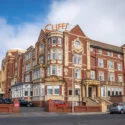









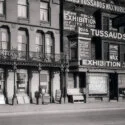







Queen’s Terrace in Fleetwood was completed in 1848, an historic row of elegant houses designed by Decimus Burton. Originally known as Burton’s Houses, the terrace was renamed to honor Queen Victoria’s visit in 1847. It has served various purposes throughout its history, including residential homes for wealthy families, a school, a hospital, and even wartime consulates. The terrace is recognized as an outstanding example of English Classical architecture. Decimus Burton, a prominent architect, designed the terrace as part of his overall plan for the new town of Fleetwood. The buildings are characterised by their English Classical style, with features like…
Author: Ed
Fleetwood Market – One of Lancashire’s Oldest Markets
Fleetwood Market is a Victorian market hall in Fleetwood, Lancashire. Located between Adelaide Street and Victoria Street, it was established in 1840, making it one of the oldest markets in the county. In 1235, King Henry III granted a market charter to Rossall manor. This included the future site of Fleetwood, but it was not for another 605 years that Sir Peter Hesketh-Fleetwood, then lord of the manor, and his wife, Lady Hesketh, established a market. The original building was constructed of wood with a slate roof. Local purveyors sold farm produce alongside textiles and clothing from traders from Manchester….
The Steamer Hotel in Fleetwood
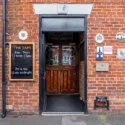
The Steamer Hotel in Fleetwood, named after the Ardrossan to Fleetwood steamer service, was the third public house established in the town and opened in 1840. It is located in one of Fleetwood’s oldest areas, Queen’s Terrace, and was originally built with stables and an ostler’s workshop at the rear. The hotel’s original design mirrored the neighboring houses, with ornate signage above the gutter line. The Steamer was a key part of Fleetwood’s development as a stopping point for travelers heading north by train and then by boat. The area’s growth likely contributed to the pub’s success. The building’s original…
The Mount Church in Fleetwood
Perched on Mount Road in the coastal town of Fleetwood, the Mount Church stands as a quiet witness to centuries of faith and community life, its distinctive red brick and sandstone architecture blending seamlessly with the surrounding Victorian townhouses. Originally a Primitive Methodist chapel rooted in the Wesleyan revivals of the late 19th century, the building first served as a Sunday School for St. George’s Primitive Methodist Church before becoming a church in its own right. Its design, characteristic of early 20th-century Methodist architecture, features two turrets flanking a central window, sandstone reveals, and dressed stone that add a dignified…
The Mount Pavilion in Fleetwood
The Mount is a pavilion in Fleetwood, Lancashire. Built in 1902 to a design by Decimus Burton, the structure has been Grade II listed by English Heritage since 1989. The building, which stands atop a large sand dune originally known as Tup’s Hill overlooking the Irish Sea, replaced a pagoda designed by Burton, around which he planned the layout of Fleetwood. The pavilion is constructed of roughcast brick with tile roofs. It has an octagonal dome with a copper roof. Part of a 7-acre (2.8 ha) site, it is located between The Esplanade to the north and Mount Road to…
Wyre Light – Fleetwood’s Third Lighthouse
The Wyre Light was a forty-foot (12 m) tall iron screw-pile lighthouse marking the navigation channel to the town of Fleetwood, Lancashire. Construction began in 1839 and was undertaken by Alexander Mitchell and Son of Belfast utilising a screw pile construction he had developed during construction of the Maplin Sand lighthouse in the Thames estuary in 1838. The Wyre Light was first lit in 1840 and was the first screwpile lighthouse ever to be lit. Although construction of the Maplin Sands Light on the northern bank of the Thames estuary had started before Wyre Light, the latter was completed in…
Fleetwood’s Lower Lighthouse
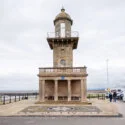
The Beach Lighthouse (also known as the Lower Lighthouse) is a 44-foot (13 m) tall sandstone lighthouse in Fleetwood, Lancashire, England. The lighthouse was designed in 1839 by Decimus Burton and Capt H.M. Denham. Burton had been commissioned three years previously by Sir Peter Hesketh Fleetwood as the architect of the new town of Fleetwood. Unusual for a lighthouse, it is in neoclassical style with a square colonnaded base, square tower, and octagonal lantern and gallery. The Lower Light stands on Fleetwood sea front and was built with its counterpart—the Upper Light, or Pharos Lighthouse—to provide a navigational guide to…
The Windmill at Marsh Mill Village in Thornton
Marsh Mill Village, located in Thornton, near Blackpool, is a historic site centered around Marsh Mill, an 18th-century windmill. It was built in 1794 by Ralph Slater for Bold Hesketh and was a corn mill used to grind grain until the 1920s. Wyre Council leased the mill from Melrose Development Services for 25 years before the lease ended. Melrose Development Services then bought the mill from the council for £1.4 million. The surrounding area has been developed into Marsh Mill Village, a courtyard complex that includes retail units, offices, and the Tavern at the Mill pub. There is also a fine…
Blackpool’s Ray Allen Brings KFC to Britain
Born in Blackpool in 1927, Ray Allen originally aspired to study medicine, as he enjoyed physics and chemistry at secondary school. However, he changed his mind after failing the compulsory language component of the university entrance exam. His future plans were further delayed when he was called up to serve in the Second World War, joining the Royal Navy at the age of 18. Owing to his scientific background, he was trained as a radar technician and stationed at the naval base at Lossiemouth in Scotland, rising to the rank of Petty Officer within a few months. After leaving the…
The Carnegie Library Opens in Lytham St Annes
The Carnegie Library is in Lytham St Annes, Lancashire. The foundation stone of St. Anne’s Library was laid in August 1904 and the building was officially opened on 10 January 1906. The land was given by the St. Anne’s on the Sea Land and Building Company, and Andrew Carnegie paid for the building itself. This was the first library in the town. Until 2016, there was also a library at Lytham. The library was administered by the St Anne’s on the Sea Urban District until 1922 when the Urban District Council amalgamated with Lytham UDC to form the municipal borough…